|
When I first (and second) saw this illustration, I thought, “‘Buying water’? What’s that about?” Consequently I had never used it on the website. (Well, to be truthful, most of the pictures we’re seeing in the Random Walk are ones I hadn’t used on the website; that’s why we’re doing this study! But in this particular case, the picture confused me.) Besides that, I thought the armed men were the ones buying water, maybe Romans buying water from the Judeans. But I did a little searching in the Bible, and I learned that the children of Israel had to buy water at one stage of their journey from Egypt to Canaan. I’ve read this scripture passage quite a few times, and either I never noticed or I promptly forgot that God instructed them to buy water – with cash money – from the descendants of Esau, the brother of Jacob. The descendants of Esau were also under God’s protection, and he forbade his people to molest them in any way, for example, by stealing water from their wells. So here’s an illustration of a minor point that struck the artist as interesting. Because of his interest, it’s a point that I won’t be forgetting again any time soon. Previous Step. Next Step. |
 "Buying Water," from the Binns family Bible, now in the private collection of Regina Hunter. |
Deuteronomy 6:1-25 (9/17/12)
The most important prayer in Christianity is, of course, the Lord’s Prayer, which I dare say is known and prayed regularly by about 99% of the world’s Christians. (The other 1% hasn’t yet learned to talk.) We teach our children this prayer before they even know what the words mean or how to pronounce them properly, which leads us to great amusement when they say things like “deliver us some email.”
The most important prayer in Judaism is the Shema (pronounced “sh’ma), “Hear, O Israel, the LORD our God, the LORD is one” (Deuteronomy 6:4). An observant Jew prays the Shema daily and wants it to be the last thing he says in this life. I suspect it’s one of the first things taught to a Jewish child. The Hebrew shema means Hear! After 40 years in the desert, the children of Israel are finally ready to hear as Moses tells them, “There is one and only one God, our LORD. Love God with all your heart, mind, soul, and strength.”
Deuteronomy 7:1-16 (9/18/12)
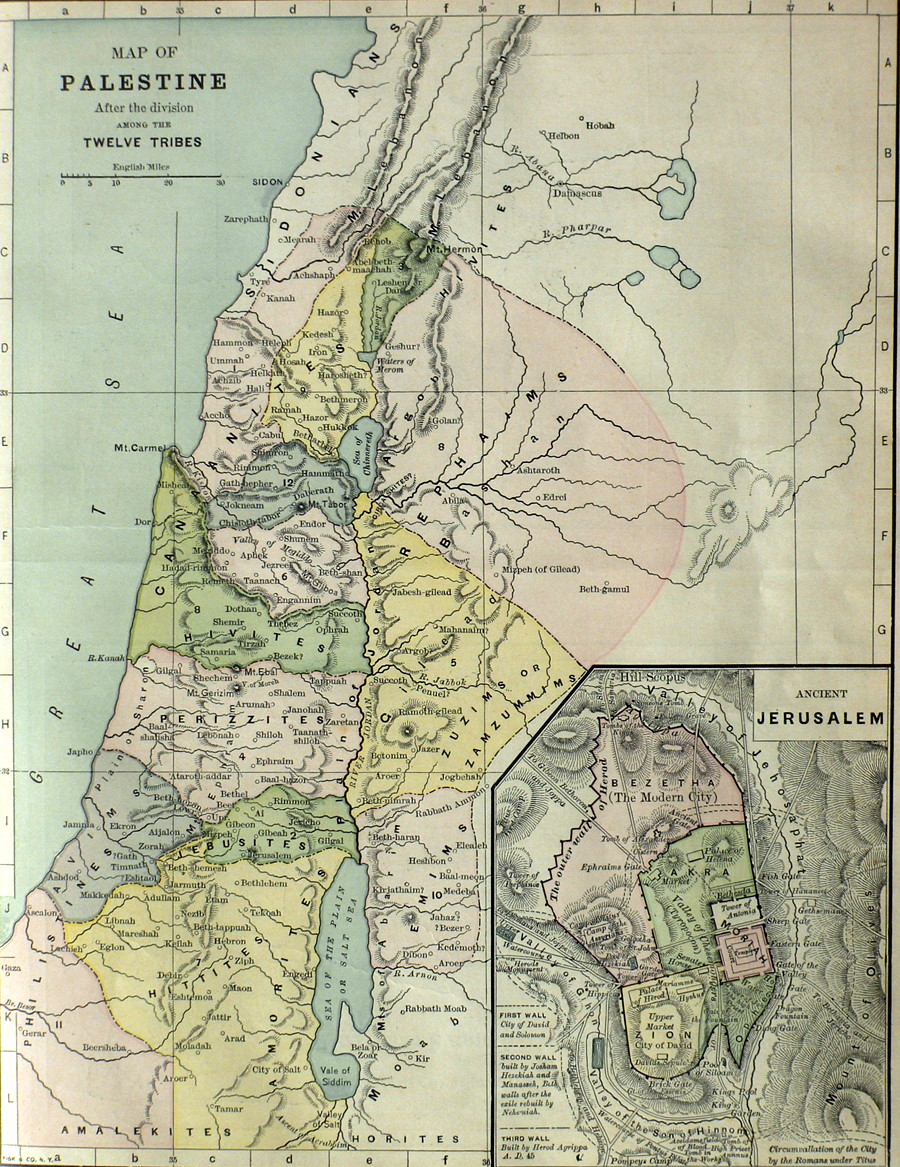
The seven nations of Canaan (vs. 1) are typically mentioned as a group. I don’t see the Girgashites, but everybody else is on the map.
Deuteronomy 8:1-20 (9/19/12)
Wouldn’t you just love to have the opportunity to prove that great wealth would not ruin you? Yet all too often, we read about people who are ruined by sudden wealth – sports figures, movie stars, lottery winners… These folks seem to forget who they are, and they think they can spend any amount of money on anything they want, because they “deserve” it. Then the collection agencies (or the police) come in, and they are worse off than they were before.
This is exactly what Moses is warning the children of Israel against. God is about to give them great wealth – rich land, already planted with orchards and vineyards; cities already built; mineral rights; the whole shebang. Moses says, “Don’t forget who you are: a people who didn’t amount to much until God chose you for his own purposes. Don’t ever think that you deserved all of this or earned it yourself. And especially don’t forget to worship God, who gives it to you, because otherwise you will be worse off than you were before.”
Deuteronomy 9:1-29 (9/20/12)
I don’t know about you, but when something good happens to me, I think it is because I am so charming, intelligent, beautiful, and law-abiding. And when something bad happens to me, it’s nothing to do with me – it’s because the universe is unfair!!!
Moses warned the children of Israel against this attitude. “Something wonderful is about to happen to you,” he says, “and it has nothing to do with you. You are stubborn, whining, law-breaking, and impatient. God has considered giving up on you several times, and you would have deserved that. But since God is determined to bless the world through Abraham, he’ll put up with you a while longer.”
Deuteronomy 29:1-29 (9/21/12)
I once had a Bethel student who said at the end of two years of biblical study, “This used to be my parents’ religion, but now it is my religion.” The children of Israel would really understand that. For 40 years in the desert, they have heard about God’s covenant with Abraham, Isaac, and Joseph. Now God is renewing the covenant, with them. Of course, Moses takes this opportunity to warn them of the dangers of breaking God’s Law after they have accepted the covenant.
Deuteronomy 30 (9/24/12)
Several weeks ago I said, about half-seriously, that chapter and verse numbers are the blessing and the curse of Bible study, and now this is being illustrated by The Story, which doesn’t include them. Reading may be easier, but discussion is harder, because you have to say things like “on the bottom of page 67, there right above the last paragraph, down to the second sentence of the next paragraph” instead of “Exodus 33:15-18.” But still, I was only about half serious.
This morning Pastor Craig said that bacon is okay under the Law if you dip it in chocolate. I punched the air and said, “Yes! Leviticus!” Everybody laughed at his joke, and the people around me laughed at me. They all realized that we were joking. On the other hand, I once told a Bethel class that Leviticus says, “Chocolate makes all things holy,” and because they were new to Bible study, they believed me and wanted to know where it said that.
Folks, don’t believe me about what the Bible says – read it for yourself! Don’t believe Pastor Craig, or your own pastor, rabbi, Sunday School teacher, or bishop, either. Sometimes we make mistakes – either because we misquote, misspeak, or misunderstand – and sometimes we are joking. The only way you can defend yourself against us is to read the Bible for yourself. Meantime, pray for God to guide our hearts, minds, mouths, and fingertips when we try to help you understand your Bible.
Moses talked to the Israelites about blessings and curses, and he wasn’t joking.
Deuteronomy 31:1-6, 14-15, 30 (9/25/12)
On the topic of jokes again: When Pastor Craig and I were talking after church Sunday, we agreed that the Bible is full of funny stories. Mostly they aren’t jokes like “A Levite, a Moabite, and an Amorite walked into a tent,” although I wouldn’t rule that out. But there are puns and other types of word play, riddles, satire, sarcasm, witty debates, exaggeration, talking animals and plants, slapstick, and teasing, to name a few.
Now, the reason we don’t recognize the puns and word play is that those are almost impossible to translate from one language to another. But I think the main reason that we don’t recognize the rest of them is that we are convinced that the Bible is SERIOUS. It is serious, but the prophets criticized idolatry by being extremely sarcastic. The writer of Jonah used scathing satire to condemn our attitudes toward people outside the church or synagogue. The blind beggar in John 9 was one of the wittiest stand-up comics of all time – and it got him thrown out of the synagogue by people who were too SERIOUS to recognize a miracle when they saw one.
God and Moses argued with each other: “Your people did this.” “My people? My people? Since when are they my people??” Even so, both God and Moses seriously loved the children of Israel, and they got them to the Promised Land in spite of themselves. There’s hope for us yet, even when we don’t get the joke.
Deuteronomy 32 (9/26/12)
When my kids were little, one of them wanted to talk to me every time I was on the phone. I always asked, “Is this a matter of life and death?” and while he was thinking it over, I’d continue my call. One day while I was on the phone, he rushed up and said, “Mom! It’s a matter of life and death!” I immediately said, “I have to go. Bye!” and hung up. It turned out that our cat was walking along the top of a 7-foot-high fence, which looks very dangerous when you are only three and a half feet tall.
Moses has seen the Israelites engaging in dangerous behavior: disregard for God and the Law, including the worship of other gods. He tells them: “Pay close attention to everything I’ve told you from God. It’s a matter of life and death!”
“Jeshurun” is a poetic name for Israel used only four times. It means, roughly, “upright one.” It apparently expresses an ideal of uprightness on the part of the people of Israel, since from the context of Moses’ whole sermon, he doesn’t hold much real hope for their uprightness. “Hoshea” is another way of saying “Joshua.”
Deuteronomy 33 (9/27/12)
Much ink has been spilled on the topic of why Simeon is not on the list of tribes blessed by Moses. Nobody knows why Simeon was omitted, which does not seem to prevent many people from having an explanation. If you take Joseph as two tribes – Ephraim and Manasseh – you still have twelve.
Pride of place is given to Joseph, not Reuben (the eldest) or Judah (from whom came the kings of Israel), with Levi coming in second. Nevertheless, each tribe gets a blessing uniquely suited to it. So do we.
Deuteronomy 34 (9/28/12)
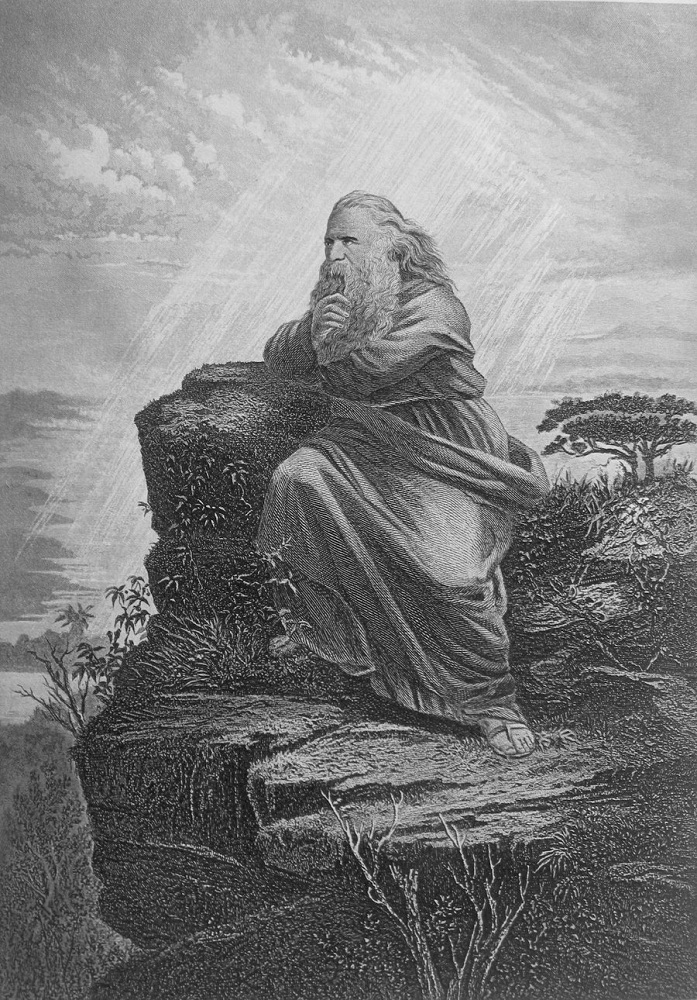
Here in Albuquerque, you can go to the top of the Sandia Mountains and see just about forever. In particular, you can see roughly the same number of square miles (maybe a little more) that Moses could see from Mt. Nebo, which is at E4 on our map.

How would you feel if God took you up there and said, “I’m giving everything you can see to your family”?
I love our picture of Moses at Mt. Nebo.
The artist has captured both Moses’ age and his vigor. He’s also captured something of what I would call, “Dang! I wish I was going out there, too!” Moses was a dedicated and powerful worker for God, and we will not see his like again in the Old Testament.
More of The Rest of The Story
Week 1. Beginning of Life As We Know It
Week 2. God Builds a Nation … Abraham … But Not Lot
Week 2. God Builds a Nation … Isaac…But not Ishmael or the sons of Keturah
Week 2. God Builds a Nation … Jacob…But not Esau
Week 3. Joseph Preserves Two Nations
Week 4. Deliverance
Week 5. New Commands and a New Covenant
Week 6. Wandering
Week 7. The Battle Begins
Week 8. A Few Good Men...and Women
Week 9. The Faith of a Foreign Woman
Week 10. Standing Tall, Falling Hard
Week 11. From Shepherd to King
Week 12. The Trials of a King
Week 13. The King Who Had It All
Week 14. A Kingdom Torn in Two
Weeks 15 and 16. God's Messengers and The Beginning of the End
Week 17. The Kingdoms' Fall
Jeremiah, Prophet of the Exile
Story 19. The Return Home
Apocalyptic writings in the Old Testament
Story 21. Rebuilding the Walls
Story 22. The Birth of the King
Story 23. Jesus’ Ministry Begins
Story 24. No Ordinary Man
Story 25. Jesus, the Son of God
Story 26. The Hour of Darkness
Story 27. The Resurrection
Story 28. New Beginnings
James, Brother of the Lord
John and Jude
Story 31. The End of Time
Copyright 2009, 2011, 2012, 2015, 2016 by Regina L. Hunter. All rights reserved. This page has been prepared for the web site by RPB.
The woodcut of Moses on Mt. Nebo is from a Bible in a family collection.
Opinions expressed on this page are solely those of the author, Regina Hunter, and may or may not be shared by the sponsors or the Bible-study participants. Thanks to the Holy Spirit for any useful ideas presented here, and thanks to all the readers for their support and enthusiasm. All errors are, of course, the sole responsibility of the author.
Our Sponsors:
St. John's United Methodist Church, "Transforming Lives Through Christ."
2626 Arizona NE, Albuquerque, New Mexico 87110
St. John's Music Ministries now has a YouTube channel, bringing you free concerts and choral music. Check it out!
Traditional worship services are held Sundays at 8:15 and 11:00 a.m. in the sanctuary. Casual worship services are held Sundays at 9:30 a.m. in the Family Life Center. Jazz Vespers are held monthly on the second Saturday at 5:00 p.m. in the sanctuary. St. John's feels especially called to the worship of God and to the service of our neighbors through our music program.
This website is supported in part by the generosity of Mrs. J. Jordan.