Exodus 1:6-22 (8/27/12)
The Hebrews increased dramatically in numbers while they were in Goshen, and the new pharaoh, who owed nothing to Joseph, got worried. He put together a plan for retroactive birth control, also known as infanticide. When he left it to the midwives alone, they didn’t cooperate, so he broadened the requirement to make everyone responsible for killing the Hebrew baby boys.
Exodus 2:1-25 (8/28/12)
I once worked for a fellow who called one of his sons “Pete.” I asked why, since I knew the boy’s name was Thomas or something like that. He explained that it was for the same reason he called the other one “Butch.” Aha! I understood that, because my granddad assigned nicknames to all of us shortly after birth, and he never called us anything else. “Pete” had nothing to do with “Thomas”; it was a nickname.
Something that puzzles us when we read the Bible, especially the Old Testament, is a statement like “She called him Moses, because she drew him out of the water.” What?? To us it sounds like the name and the reason have nothing to do with each other. Well, in Hebrew, Moses is Mosheh, and draw out is mashah. Similarly, Gershom in Hebrew is Garashon, and expel or drive away is garash. If you always assume that the name of the person or place sounds like the reason given, you will be right about 99% of the time.
The most important verse in today’s reading is the last one: “And God's eyes were turned to the children of Israel and he gave them the knowledge of himself.” God wants us to know him.
Exodus 3:4-17 (8/29/12)
Yesterday I mentioned that if you are reading The Story, you should definitely read the Preface. One thing you will learn is that extra space between the lines of text means that something has been omitted. For example, the second space at the top of p. 9 omits the verse, “And Noah did all that the LORD commanded him.” Now, most likely it was omitted because it repeats what was said just a few verses before; however, things that are said twice may be merely repetitious, or they may be repeated because they are important. In this case it is important that Noah did all that the LORD commanded, because it is answering the question, “Why Noah?”
Anyway, today we see two repetitions of a promise that occurs dozens of times in the first five books of the Bible: God’s promise to give the descendants of Abraham a good land, flowing with milk and honey. We saw this promise first in Genesis 12:1 and 12:7, and the promise to Abraham is referred to about 50 times in one form or another. It is important, not merely repetitious, that God has promised to make Abraham into a mighty nation with its own land.
Exodus 4:1-16; 5:1-4 (8/30/12)
My sympathies are altogether with Moses. God told him to do something he really didn’t want to do because he lacked critical skills for it (I’ve been there), and then when he tried to do it, Pharaoh wouldn’t let him (and I’ve been there, too).
On the other hand, you’ve got to feel God’s exasperation when Moses argues with him for 45 minutes about whether he, Moses, is going to go, and then says, “O Lord, send, if you will, by the hand of anyone whom it seems good to you to send.” MOSES! IT SEEMS GOOD TO ME TO SEND YOU!
But the really great thing about this passage is that we have a God who is willing to listen to our objections and work with us to find a way around them. You lack credentials? God will persuade people to listen. You lack confidence? God will give it to you. You lack time, talent, or skill? God will give you helpers.
Exodus 7:1,8-23 (8/31/12)
Of course I know that you all memorize my comments! However, for those very few of you with busy lives, you might want to take a second to review what I said about Genesis 1:1-19
Brief summary: only God is God; there are no gods.
We come back to exactly that point today. When God says to Moses, “I have made you a god to Pharaoh,” we need to pay attention. The Egyptians had many gods and goddesses; the primordial goddess in the Egyptian pantheon was Amunet, who was depicted as a cobra or snake-headed woman. Amunet remained especially popular in Thebes, where she was seen as the protector of Pharaoh. Thebes was the capital of Egypt during the 11th and 18th dynasties. The 18th Dynasty ran from about 1550 to about 1292 BC, and Moses lived about 1526 to 1406 BC, according to The Story. So Amunet was most likely important to Pharoah during the time of Moses.
Similarly, Hapi, the god of the inundation of the Nile, was sometimes considered to be the father of the other gods.
So when God provides a staff that changes to a snake and back to a rod at the hand of Moses, and Nile water that turns to blood, he is demonstrating power over the other so-called gods. God really is making Moses a “god” to Pharaoh! Unfortunately, Pharaoh seems to have been a bit of an agnostic.
Exodus 8:1-19 (9/3/12)
Back when I was teaching Bethel, I got so many questions about the hardening of Pharaoh’s heart that I finally wrote a little paper about it. Now that we’re getting to that topic in this email study, I put it on the website.
Brief summary: Pharaoh hardened his own heart, and in any case it means “was stubborn.”
We’re not going to read about every single plague here. Fellow-reader Ginger J. is a little puzzled that the Egyptian wonder-workers were able to reproduce some of Moses’ earlier miracles. Well, have you ever watched David Copperfield? Stage magicians are able to work some really stunning effects, and it ain’t all camera angles, folks. Their tricks look incredibly convincing, but the important words there are “tricks” and “look.”
What is more interesting to me is that by the end of the third plague, the wonder-workers, which is the BBE’s translation of “magicians,” apparently were not able to make the frogs go away, and they weren’t able to produce insects at all. They even tell Pharaoh that he is dealing with the acts of God, but Pharaoh isn’t convinced.
Exodus 9:1-16 (9/4/12)
Fellow-reader Larry L. finds it “fascinating that the Lord uses natural disasters for his plagues… He uses disasters that people understand.” I agree. Many of the plagues seem to be directed against specific Egyptian gods, most of whom were associated with specific natural phenomena. I mentioned the snake goddess and the Nile god, but I didn’t mention yesterday that there was also a frog goddess. Surprisingly enough, there doesn’t seem to have been an insect god, although there was a god of scarab beetles. There was also a god of deserts, storms, evil, and chaos, which may cover the insects, dust, and boils. No plague was associated with earthquakes or volcanoes – the Egyptians apparently had no gods for those, so what would have been the point?
So I think there are several purposes for the plagues. The principal reason was as a demonstration of God’s real power, a power that extended even over other gods. God makes this point in vs. 16 and in several other places. Who needed this demonstration? Both the children of Israel and the other nations. Obviously not the gods, since they weren’t real. But the Egyptians thought they were real, and so did the Israelites. God always speaks to us in ways that we can understand.
A second big reason was to show the children of Israel that this powerful God who had chosen them would use power on their behalf. Granted, they did not especially appreciate this point until much later.
Exodus 10:1-29 (9/5/12)
Pharaoh was stubborn, but not stupid. He didn’t want to let the Israelites go out into the desert, and he was stubborn about that. After several plagues showing the power of God, he was eventually ready to let the men go knowing that they had families and flocks to come back to. After a couple more plagues, he was even willing to let them take their families. But when Moses said that God wanted them to take their flocks as well, Pharaoh realized that they would have no reason to return, and he cut off the negotiations entirely.
Exodus 11:1-10 (9/6/12)
Fellow-reader Nancy S. inquired about the only miracle I could think of that seems to defy the laws of physics. Joshua 10 reports that the sun and moon stood still at the command of Joshua while the Israelites defeated the Amorites. Apparently the written form of the story came to us later, because even Joshua 10:14 comments that “there hasn’t been a day like that before or since.” Do I detect the faintest note of skepticism there? Some days seem longer than others, that’s for sure.
On the other hand, fellow-reader Ginger J. points out that Moses and Aaron were able to predict the coming of each plague, which contains an element of the miraculous in its own right.
The main thing to remember about miracles is what George Burns said in “Oh, God!”: “I don’t do miracles. They’re too flashy, and they upset the natural balance.” Of course, then he does a little miracle, making rain inside of John Denver’s car. Why? To build his faith. Miracles are by nature rare. Normally they are a matter of balance, not of the impossible, and often they are a matter of building faith and confidence in God. Occasionally you get good theology out of Hollywood, which may qualify as a miracle.
Exodus 14:8-18, 28-31 (9/7/12)
Fellow-reader Rob E., like Larry L., is curious about whether the plagues could have been the result of natural phenomena, noting that every so often you see an article saying that science has documented real events that could well have been the Biblical plagues.
Well, I don’t drag this fact out very often, but I, too, have a Ph.D. in science, specifically in geology, with a specialty in paleontology and lots of hours in biology. Allowing for the fact the Moses and the other Biblical writers did not have Ph.D.s in science, I think they did an exceptionally fine job of recording what really happened. The fact that you can say, aha, here is a perfectly natural way that this thing could have happened probably means that that is exactly what happened. Any other explanation gets needlessly complicated. However, the Bible is more interested in why it happened, namely, to impress the children of Israel with God's power, and to force Pharaoh to let them go.
My husband, a clergyman, says that in many cases, a miracle doesn’t consist primarily of the event that happened, e.g., lots of frogs. Rather, the miracle consists primarily in the timing of the event. Moses holds up his staff to demonstrate the power of God, and at that time the waters recede and the Israelites escape.
My own feeling is that after creating the laws of physics and chemistry and the raw materials of biology and geology, God probably feels justified in using these laws and materials preferentially whenever he wants to work miracles. There are very few miracles in the Bible (I can think of one, off hand) that don’t seem to be in line with the ordinary laws of the universe. And why not? God wrote the laws of the universe! The miracle is that God caused the plagues to happen at the precise time that they needed to happen to deliver the Israelites from the hand of Pharaoh.
More of the Rest of The Story
Week 1. Beginning of Life As We Know It
Week 2. God Builds a Nation … Abraham … But Not Lot
Week 2. God Builds a Nation … Isaac…But not Ishmael or the sons of Keturah
Week 2. God Builds a Nation … Jacob…But not Esau
Week 3. Joseph Preserves Two Nations
Week 4. Deliverance
Week 5. New Commands and a New Covenant
Week 6. Wandering
Week 7. The Battle Begins
Week 8. A Few Good Men...and Women
Week 9. The Faith of a Foreign Woman
Week 10. Standing Tall, Falling Hard
Week 11. From Shepherd to King
Week 12. The Trials of a King
Week 13. The King Who Had It All
Week 14. A Kingdom Torn in Two
Weeks 15 and 16. God's Messengers and The Beginning of the End
Week 17. The Kingdoms' Fall
Jeremiah, Prophet of the Exile
Story 19. The Return Home
Apocalyptic writings in the Old Testament
Story 21. Rebuilding the Walls
Story 22. The Birth of the King
Story 23. Jesus’ Ministry Begins
Story 24. No Ordinary Man
Story 25. Jesus, the Son of God
Story 26. The Hour of Darkness
Story 27. The Resurrection
Story 28. New Beginnings
James, Brother of the Lord
John and Jude
Story 31. The End of Time
Copyright 2012 by Regina L. Hunter. All rights reserved. This page has been prepared for the web site by RPB.
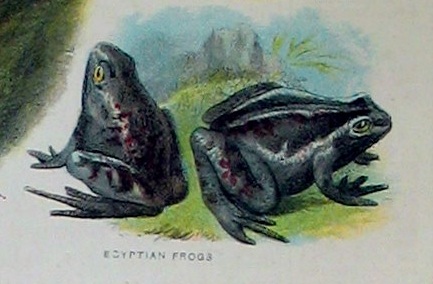
The woodcut showing Egyptian frogs is from the Binns family Bible,
now in the private collection of Regina L. Hunter.
Opinions expressed on this page are solely those of the
author, Regina Hunter, and may or may not be shared by the sponsors or the
Bible-study participants. Thanks to the
Holy Spirit for any useful ideas presented here, and thanks to all the readers
for their support and enthusiasm. All
errors are, of course, the sole responsibility of the author.
Our Sponsors:
St. John's United Methodist Church,
"Transforming Lives Through Christ."
2626 Arizona NE, Albuquerque, New Mexico 87110
St. John's Music Ministries now has a YouTube channel, bringing you free concerts and choral music. Check it out!
Traditional worship services are held Sundays at 8:15 and
11:00 a.m. in the sanctuary. Casual worship services are held Sundays at
9:30 a.m. in the Family Life Center.
Jazz Vespers are held monthly on the second Saturday at 5:00 p.m. in the sanctuary. St. John's feels especially called to the worship of God and to the service of our neighbors through our music program.
This website is supported in part by the generosity of Mrs. J. Jordan.