The Rest of The Story –
Story 2: God Builds a Nation
Abraham … But Not Lot
Genesis 11:27-12:10
Genesis 13:1-18
Genesis 14:8-24
Genesis 18:16-33
Genesis 19:1-29
Random Walk in a Gallery of Religious Art, Step 67: Genesis 19:10-22, The Escape of Lot, by Peter Paul Rubens
Isaac…But not Ishmael or the sons of Keturah
Genesis 21:1-11
Random Walk in a Gallery of Religious Art, Step 19: Genesis 21:8-21, Hagar expelled
Genesis 21:12-21
Genesis 24:1-16
Genesis 24:50-67
Genesis 25:1-21
Jacob…But not Esau
Genesis 25:21-34
Genesis 26:34-35, 27:46, 28:1-22
Genesis 29:1-16
Genesis 31:55-32:1-9, 32:22-30
Genesis 35:1-8, 9-15, 21-29
More of the Rest of The Story
Copyright information, disclaimers, and sponsors
Return to homepage
Abraham … But Not Lot
Genesis 11:27-12:10 (7/30/12)If the first chapter of the Bible is “Things Go Wrong,” this next section might be called, “God Tries Again.” I can sort of imagine God shaking his head about how badly people have gotten into trouble, and then thinking, “What if I choose just one family, and work with them to save all the others?” So God says to Abram, “Come with me, and I’ll bless you.” Sounds good to Abram, so he gathers up his wife Sarai and his nephew Lot and all their shirt-tail relations and employees, and off they go. Here’s our chart of the family of Abram and Sarai. You may want to refer back to it in the coming weeks.
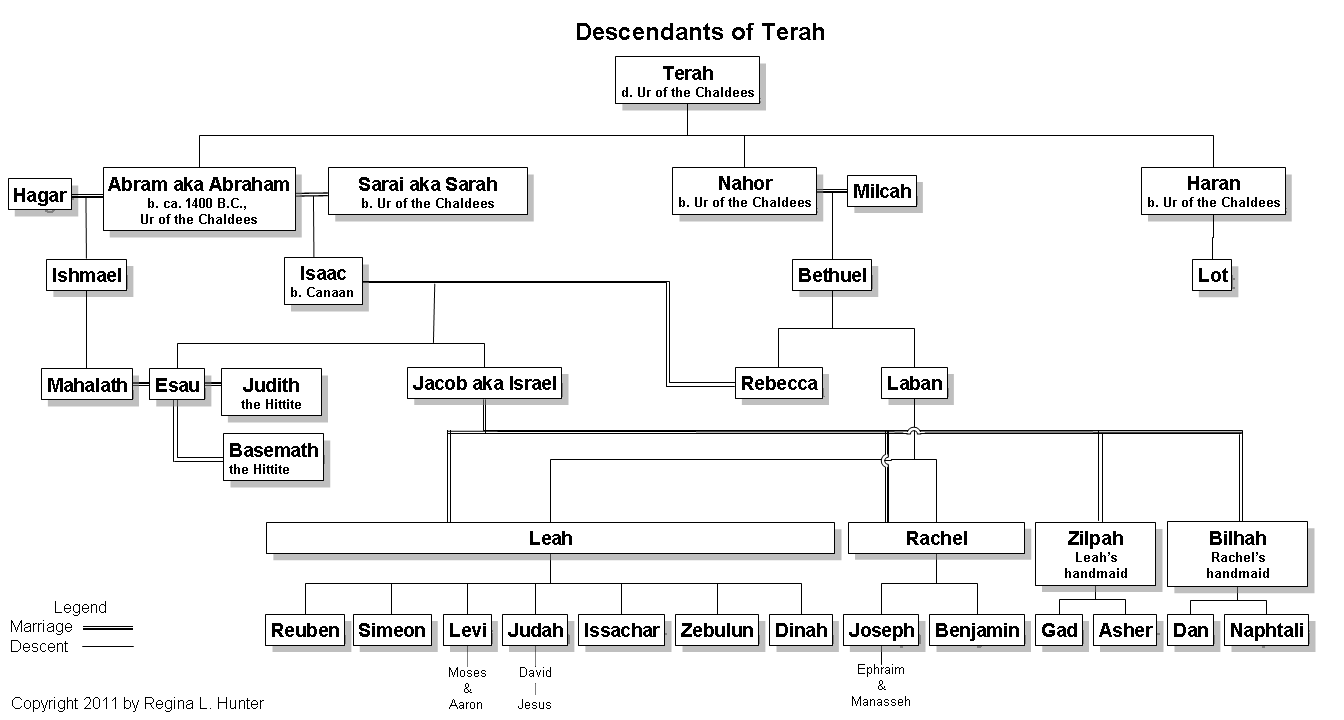
I suggest that you memorize Genesis 12:1-3. The Bible refers back to these verses so many times that they have been called “the topic sentence of the Bible.” If you thoroughly understand the relationship between God and Abraham, it will help you understand God’s plan for salvation of the universe, which has three main points:
- I will bless you.
- So that you will be a blessing.
- The world will be blessed through you.
Genesis 13:1-18 (7/31/12)
Yesterday I wondered why God chose Abram and not his neighbor Ed up the street, and I suggested that it might have been because Abram responded to God when he was called. Today I want to look at a slightly different question: Why did God choose Abram as opposed to doing nothing?
God had seen how much trouble we get into when we are left on our own—that’s what we read about in Genesis 3 to 11. Sin is like a tar pit: once you get in, you can’t get out on your own. And once you are a sinner, you can’t come into the presence of God. This is as much a problem for God as it is for you, because God loves you and wants you to be with him.
So God developed a plan for the salvation of humanity in which he was ultimately going to have to drag us out of the tar pit. This presented the next problem: how do you save all of humanity at once? They aren’t listening, because they are perfectly happy in the tar, thank you very much. So God had to develop a whole nation of people who would listen. Abram, who had demonstrated his listening skills, was God’s choice to be the founder of this nation.
Now, Lot, as Abram’s nephew, seems like a good candidate for co-founder. He’s a close relative, presumably with the same sort of background as Abram, and he’s willing to emigrate with Abram and Sarai from Haran to Canaan. This week we’ll see why Lot didn’t work out. His first mistake was choosing to separate himself from Abram and move to the city of Sodom.
Genesis 14:8-24 (8/1/12)
Well! There are so many interesting things about this passage that it’s hard to know where to start. But the most interesting thing to me is that I usually think of Abraham as a really old guy with a long white beard. Here we see him as a vigorous younger man – mighty in battle, with his own army and strong allies – who is proud enough and rich enough not to take any of the spoils for himself. He went after Lot and what belonged to him, and Lot and what belonged to him is all he’s taking.
Lot, on the other hand, doesn’t cut a very impressive figure. He left Abram and went to live in Sodom, which went out to war and lost. Lot and his family were among the captives, and the only reason they didn’t end up in slavery is that Abram went after him.
Pay some attention to Melchizedek, who was a priest of God Most High. Apparently Abram isn’t the only person God was talking to; a few others worshipped God at that time. Melchizedek is mentioned only here, in Psalm 110:4, and in Hebrews 5, 6, and 7.
Genesis 18:16-33 (8/2/12)
We’ve all read about how the messengers of God came to Abraham to tell him that Sarah would bear him a son, in spite of their old age. The next part of the story is important, too. God is on his way to investigate two wicked cities, Sodom and Gomorrah. His intention is to pass judgment on them if things are as bad as they sound. Abraham, with great respect, suggests that God should probably spare the city if even a few of the inhabitants are righteous. This conversation shows us two things: intercessory prayer on behalf of others can be really effective, and Abraham’s covenant obligation to be a blessing to other people was consistent with his own nature.
Genesis 19:1-29 (8/2/12)
Now, as we all know, Sodom and Gomorrah were destroyed. Apparently there weren’t even 10 righteous people there. We normally think of the major sin of the Sodomites as being, well, attempted sodomy, and certainly many scholars and commenters agree with this. However, another very long tradition of Jewish and Christian scholarship holds that their primary sin was their violence toward the visiting messengers, i.e., lack of hospitality. Certainly Ezekiel 16:49-50 and Matthew 10:14-15 give support to that view.
I have to admit that lack of hospitality as a terrible sin, or even as a cultural no-no, was a puzzle to me until a few years ago, when I read an article in National Geographic (which I can’t locate now). In the Middle East, even today, hospitality to the stranger is just about the top of list of cultural values. If a stranger, even an enemy, comes to your door and you take him in, you absolutely must keep him safely in your home until he decides to leave. We think badly of Lot because he was willing to offer his virgin daughters to the mob, but by the cultural mores of his place and time, he was doing the right thing.
Even so, we have to ask ourselves, why was he there?? He chose to leave Abraham and move to Sodom, and then, presumably after meeting the neighbors, to live there! Lot lacked the spiritual discernment to realize that it’s better to work out some arrangement with a righteous man about flocks in the desert than to live in a town full of wicked men. This isn’t the last we hear of Lot; however, he is no longer a candidate for citizenship in the nation that God is building.
Random Walk in a Gallery of Religious Art, Step 67: Genesis 19:10-22, The Escape of Lot, by Peter Paul Rubens (9/2/15)
|
Sometimes my eyebrows go up a little bit when I read the International Standard Version, but I must say that the ISV and The Escape of Lot, by Peter Paul Rubens, share a sense of urgency that we can miss when we read the same old translation that we’re used to. When I was a kid, my sister and I were taught that if the house caught on fire, we were to get out as fast as possible – not stopping for anything. “Get you out of this place” (King James Version, vs. 14) is dignified, but “Get out of here!” is more appropriate for an evacuation, and it suggests that Lot and his family weren’t supposed to stop for anything. So I like the way the angels are pushing and dragging on Lot and his wife in the painting to move them along. Previous Step. Next Step. |
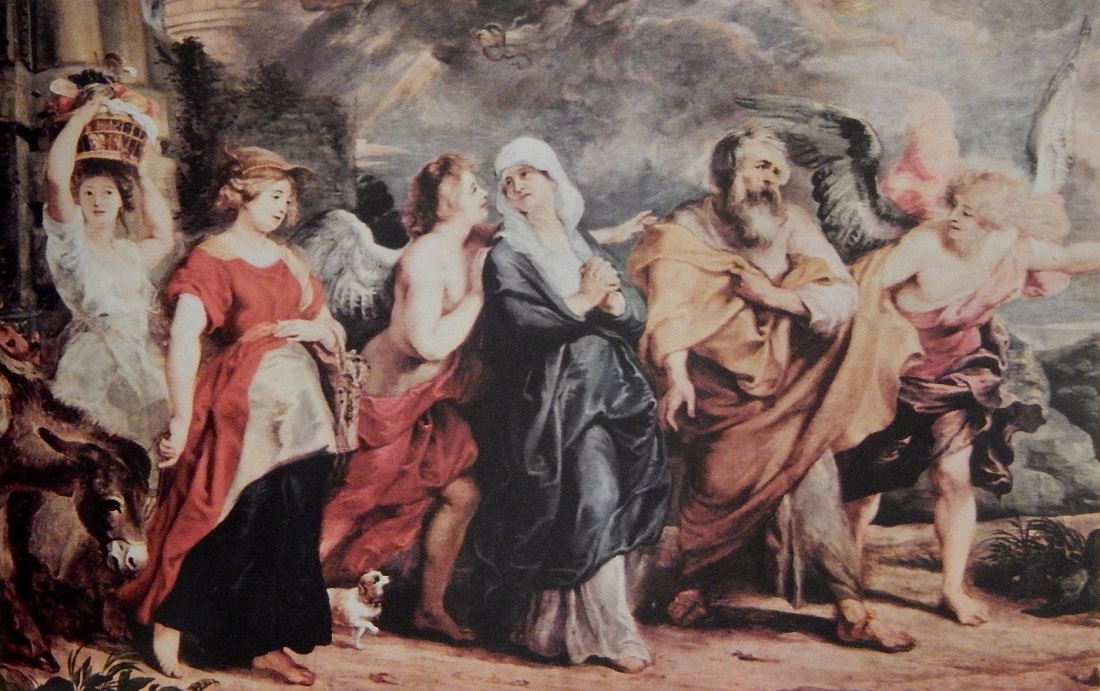 "The Escape of Lot" by Peter Paul Rubens, from the Gamble family Bible, now in the private collection of Regina Hunter. |
Isaac…But not Ishmael or the sons of Keturah
Genesis 21:1-11 (8/6/12)God has a plan to save the world, but it’s difficult – even for God – to do that with only two people on board. Therefore God promises Abraham and Sarah that they will become a mighty nation, countless as the stars. That this promise went to Abraham and Sarah is shown in part by the scripture passages we read this week. When Sarah finally has her own child, she decides to free her slave-girl Hagar and Hagar and Abraham’s son Ishmael (whom Sarah had adopted, see Genesis 16:2 and the comments here.
Sarah had the choice of freeing them or of letting Ishmael inherit along with Isaac. Ishmael, as the firstborn, would probably have received more than Isaac. Sarah would have no part of that, and she insisted that Abraham send them away. The covenant between God and Abraham thus passed to Isaac.
Random Walk in a Gallery of Religious Art, Step 19: Genesis 21:8-21, Hagar expelled (3/26/15)
|
Have you ever picked up a paperback novel with an interesting cover, only to find (200 pages later) that the cover art was apparently done by someone who had never read the book? All my sons were taller than I am by the time they were 12 or 13, and my 11-year-old granddaughter is already taller than I am. Genesis 16:16 tells us that Abraham was 86 when Ishmael was born, and Genesis 21:5 says he was 100 when Isaac was born. Even if Isaac was weaned early, Ishmael had to be at least 15 years old when Sarah insisted that Abraham free him and his mother Hagar. So what’s my point? Does that kid look 15 to you, or maybe more like 5? Furthermore, vs. 10 tells us that the driving force in their expulsion was Sarah, and vs. 11 says that the whole situation was “very evil” to Abraham. He even took pains to give Hagar and Ishmael some provisions for the road. Doré’s Abraham, on the other hand, is sternly casting them out, while Sarah huddles behind him with her “poor little victimized baby.” Read for yourself, and when the artist hasn’t read the book, you’ll know. Previous Step. Next Step. |
 "Hagar Expelled" by Gustave Doré, from the Gartin family Bible, now in the private collection of Regina Hunter. |
Genesis 21:12-21 (8/7/12)
There’s a children’s activity song called “Father Abraham,” which has the refrain, “Father Abraham had many sons; many sons had Father Abraham. I am one of them, and so are you, so let’s all praise the LORD.” Three of the great world religions descend from the sons of Abraham: Judaism, Christianity, and Islam. Judaism traces the ancestry of Moses to Abraham’s son Isaac through Isaac’s grandson Levi, and Christianity traces the ancestry of Jesus to Isaac through his grandson Judah. Muslims trace the ancestry of Muhammad to Ishmael, Abraham’s oldest son. All of these people are on the chart.
But for today, let’s think about Ishmael. God promised Hagar that he too, would become a great nation, even though he was not to inherit the covenant made with Abraham.
Genesis 24:1-16 (8/8/12)
God is building a nation of people who will listen to him and be faithful to him. So far there are three people in this nation: Abraham, Sarah, and Isaac. When it comes time for Isaac to marry, the risk of losing the nation through assimilation into the Canaanite culture is very high. Abraham gives his foreman the potentially difficult task of finding Isaac a wife who is not a Canaanite and not unwilling to leave the old country and come to Canaan! One of the greatest dangers facing Christians and Jews is assimilation into the secular culture, so we should all feel some sympathy for Abraham’s position and the foreman’s plight.
Genesis 24:50-67 (8/9/12)
God continued to work with Abraham and his immediate family by leading Abraham’s foreman to the family of Rebekah, Isaac’s first cousin once removed (see the chart). Although we learn much later that Laban has household gods, it’s clear from today’s passage that he at least knew of and had some respect for the God of Abraham. By marrying within the family and by taking up residence in Canaan (which God had promised to Abraham’s descendants), Isaac and Rebekah demonstrate their willingness to continue the covenant relationship with God.
Genesis 25:1-21 (8/10/12)
Another version of “Father Abraham” says “Father Abraham had seven sons.” Actually, he had eight. As Christians and Jews, we claim to be the “children of Abraham,” and most of us know that many Muslims do, too. (Maybe all – I just don’t know much about Islam.) We all know about Isaac and Ishmael and what became of them. How many of us knew that Abraham had six sons by a third wife, Keturah? Abraham gave gifts to these sons during his lifetime, but he reserved the inheritance – and the covenant – for Isaac.
Jacob…But not Esau
Genesis 25:21-34 (8/13/12)Human beings seem to have this thing about firstborn sons. They get the title, they get the crown, they get the biggest share of the inheritance, they get the most spankings, etc. God doesn’t seem to share this bias. We saw that Ishmael, Abraham’s firstborn son, got God’s blessing, but not the covenant. This week we see that that Esau, Isaac’s firstborn son, also didn’t inherit the covenant. One reason may be that he didn’t want it enough.
Genesis 26:34-35, 27:46, 28:1-22 (8/14/12)
Remember how determined Abraham was that Isaac should not have a wife from the Canaanite tribes? In the next generation, Esau, after trading off his birthright for some lunch, took two Canaanite wives. Rebekah wasn’t happy about this, because she was completely aware of the dangers of assimilation. She got Isaac to send Jacob off to the old country to find a wife among his cousins.
On the way there, Jacob has a vision of God. In the vision, God promises that the covenant he made with Abraham will now pass to Jacob. Jacob is awed and sets up a pillar to God to commemorate the occasion. Nevertheless, Jacob puts some conditions on the relationship: if God takes care of me, then God can live in this pillar I have set up and be my God, and I’ll be God’s man.
God works with us where we are, and at this early stage in the development of his nation, God was working with people who believed (1) that there were numerous gods, each tied to a specific territory, and (2) that gods could be manipulated. Much later, God revealed that he is the only God, omnipresent, and not subject to human manipulation. But Jacob wouldn’t have believed that, so God didn’t burden him with the information. God identified himself simply as “the God of Abraham,” not “the God of the universe.”
Genesis 29:1-16 (8/15/12)
In contrast to Esau, who married Hittite women, Jacob married within the family of Abraham and Sarah. Rachel and Leah were Jacob’s first cousins – his mother Rebekah was the sister of their father Laban. They were also second cousins, once removed, because they all descended from Terah, Abraham’s father.
All these relationships can be seen on the chart
but the main point to remember is that God’s infant nation is being kept separate from other nations, primarily in order to keep them away from the gods of the other nations. The nation that arose from Esau, Edom, worshiped other gods; see 2 Chronicles 25:20.
Genesis 31:55-32:1-9, 32:22-30 (8/16/12)
Names are important. “Jacob” means “heel catcher” or “supplanter.” That name fairly describes Jacob’s early life, during which his primary goal seems to have been to get the birthright, covenant, and blessing that Esau expected to receive as Isaac’s older son. After he has a vision of wrestling with God, however, God renames him “Israel,” which means “he will rule, like God.” This new name refers to his prominent position in forming God’s nation. Place names also can have significant meanings. “Peniel” means “face of God.”
Genesis 35:1-8, 9-15, 21-29 (8/17/12)
Notice that Jacob has his household “put away,” that is, get rid of, their foreign gods. Foreign gods have been a continual problem for God’s nation, from the earliest times until today. Whether our gods are physical idols or addictions, astrology or self-help, we need to put away whatever there is in our life that takes our attention away from God.
The nation was finally getting bigger. Jacob, also called Israel, had four wives and twelve sons (see the chart). From the twelve sons came the twelve tribes of Israel, each named after the son who founded the tribe. As time went on, the tribe of Joseph became two tribes, Ephraim and Manasseh. There were still twelve tribes, however, and to be honest I’ve never quite figured that out.
More of the Rest of The Story
Week 1. Beginning of Life As We Know It
Week 2. God Builds a Nation … Abraham … But Not Lot
Week 2. God Builds a Nation … Isaac…But not Ishmael or the sons of Keturah
Week 2. God Builds a Nation … Jacob…But not Esau
Week 3. Joseph Preserves Two Nations
Week 4. Deliverance
Week 5. New Commands and a New Covenant
Week 6. Wandering
Week 7. The Battle Begins
Week 8. A Few Good Men...and Women
Week 9. The Faith of a Foreign Woman
Week 10. Standing Tall, Falling Hard
Week 11. From Shepherd to King
Week 12. The Trials of a King
Week 13. The King Who Had It All
Week 14. A Kingdom Torn in Two
Weeks 15 and 16. God's Messengers and The Beginning of the End
Week 17. The Kingdoms' Fall
Jeremiah, Prophet of the Exile
Story 19. The Return Home
Apocalyptic writings in the Old Testament
Story 21. Rebuilding the Walls
Story 22. The Birth of the King
Story 23. Jesus’ Ministry Begins
Story 24. No Ordinary Man
Story 25. Jesus, the Son of God
Story 26. The Hour of Darkness
Story 27. The Resurrection
Story 28. New Beginnings
James, Brother of the Lord
John and Jude
Story 31. The End of Time
Copyright 2009, 2011, 2012, 2015, 2016 by Regina L. Hunter. All rights reserved. This page has been prepared for the web site by RPB.
Opinions expressed on this page are solely those of the author, Regina Hunter, and may or may not be shared by the sponsors or the Bible-study participants. Thanks to the Holy Spirit for any useful ideas presented here, and thanks to all the readers for their support and enthusiasm. All errors are, of course, the sole responsibility of the author.
Our Sponsors:
St. John's United Methodist Church, "Transforming Lives Through Christ."
2626 Arizona NE, Albuquerque, New Mexico 87110
St. John's Music Ministries now has a YouTube channel, bringing you free concerts and choral music. Check it out!
Traditional worship services are held Sundays at 8:15 and 11:00 a.m. in the sanctuary. Casual worship services are held Sundays at 9:30 a.m. in the Family Life Center. Jazz Vespers are held monthly on the second Saturday at 5:00 p.m. in the sanctuary. St. John's feels especially called to the worship of God and to the service of our neighbors through our music program.
This website is supported in part by the generosity of Mrs. J. Jordan.