Singing from Advent to Epiphany –
Christmas Carols
Luke 1:8-17, In the Bleak Midwinter (12/2/2009)
Today we start looking at Christmas carols with "In the Bleak Midwinter." The Jewish calendar has 12 regular months, like Nissan, which is the month Passover comes in, and Teves, which is the month that Hanukkah comes in. It's fundamentally a lunar calendar, but since the lunar month is 29.5 days long and the lunar year rapidly gets out of sync with the solar year, there's a fairly complicated system of leap months. I believe we are currently in the year 5770. The point is that the Biblical writers could have given us the date for every recorded event, but they normally didn't, apparently not considering that the dates were all that important.
One event that we don't know the date of – or even the month or season – is Jesus' birth; however, the Christ mass has been celebrated on Dec. 25 since about the year 350 A.D. Since there's no scriptural basis for the winter, snow, or ice in this carol, our reading is about Zechariah and the angel Gabriel, who announced the forthcoming birth of John the Baptist.
-
In the bleak midwinter, Frosty wind made moan,
Earth stood hard as iron, Water like a stone;
Snow had fallen, snow on snow, Snow on snow,
In the bleak midwinter, Long ago.
Our God, heaven cannot hold him, Nor earth sustain;
Heaven and earth shall flee away When he comes to reign;
In the bleak midwinter A stable place sufficed
The Lord God Almighty, Jesus Christ.
Luke 1:26-33, Ave Maria (12/3/2009)
The first three lines of Ave Maria come from today's scripture reading in Luke. Notice that Gabriel has been sent to Mary as well as to Zechariah, but since she doesn't question his credentials, he's nicer to her.
| Ave Maria | Hail Mary, |
| Gratia plena | full of grace, |
| Dominus tecum | the Lord is with thee; |
| Benedicta tu in mulieribus | blessed art thou among women, |
| Et benedictus fructus ventris | and blessed is the fruit of (thy) womb, |
| Tui, Jesus | (thy), Jesus |
| Sancta Maria | Holy Mary, |
| Mater Dei | Mother of God, |
| Ora pro nobis peccatoribus | pray for us sinners, |
| Nunc et in hora mortis nostrae | now and at the hour of our death. |
| Amen. | Amen. |
Random Walk in a Gallery of Religious Art, Step 68: Luke 1:26-38, Annunciation, by Bartolomé Esteban Murillo (9/3/15)
|
The Annunciation, by Bartolomé Esteban Murillo, excellently shows the humility of the Virgin and the unaccustomed gentleness of the Archangel Gabriel. You may remember that Gabriel was a little short-tempered with Zachariah’s question (Luke 1:19-20); however, he treats Mary kindly and patiently. All that is a good reflection of the scripture. Then Murillo gets carried away with baby angels, of whom I count at least eleven. Now, if you were paying attention during our study of Angels, you will not remember any baby angels. You will remember instead that most angels are scary, hard-working messengers, servants, and soldiers of Almighty God. I don’t know where the idea of these adorable little winged babies came from, nor the idea of the winged anorexic 16-year olds that we see more often today, but I can assure you that neither idea comes from the Bible! The bottom half of the painting is great, though. Previous Step. Next Step. |
 "Annunciation" by Bartolomé Esteban Murillo, from the Gamble family Bible, now in the private collection of Regina Hunter. |
Micah 5:2-5a, O Little Town of Bethlehem (12/4/2009)
Bethlehem's primary importance came from its status as the hometown of King David and the prophecy of Micah that the Messiah would come from there. This made sense, because the Messiah was going to be a descendant of David. This is one reason the claim that Jesus was the Messiah met with some skepticism: he was from Nazareth, as far as anybody knew. Nathaniel said, "Can any good thing come from Nazareth?" (John 1:46) After Jesus gave sight to the man blind from birth, one objection made by the religious authorities was, "We don't know where he came from." The blind man sneered, "He gave sight to someone blind from birth, and you don't know where he came from?!" (John 9:29-30) Some people argued that in fact no one would know where the Messiah came from (apparently a minority view), and since they did know where Jesus was from (Nazareth), he couldn't be the Messiah (John 7:27). Ironically, they in fact didn't know where he was from – the little town of Bethlehem.
-
O little town of Bethlehem, How still we see thee lie!
Above thy deep and dreamless sleep The silent stars go by;
Yet in thy dark streets shineth The everlasting light;
The hopes and fears of all the years Are met in thee tonight.
Matthew 1:18-25, Silent Night, Holy Night (12/7/2009)
Quick! What did the angels sing? Not "Alleluia" at all, but reather "Glory to God in the highest." The English "alleluia," as we all know by now, is a direct transfer from the Greek alleluia, which is a transliteration, not translation, of the Hebrew hallelujah. Whenever you see "Praise God!" in your Old Testament, you know that the Hebrew has hallelujah, which means, "y'all praise God!"
-
Silent night, holy night
All is calm, all is bright
Round yon Virgin Mother and Child
Holy Infant so tender and mild
Sleep in heavenly peace.
Silent night, holy night!
Shepherds quake at the sight
Glories stream from heaven afar
Heavenly hosts sing Alleluia!
Christ, the Saviour is born.
Silent night, holy night
Son of God, love's pure light
Radiant beams from Thy holy face
With the dawn of redeeming grace
Jesus, Lord, at Thy birth.
Luke 2:1-7, Away in a Manger (12/8/2009)
Caeser Augustus ruled the Roman empire from 31 BC until AD 14. Herod the Great, who ruled Judea when Jesus was born, died about 4 BC. There is some disagreement about whether Quirinius was "governor" or "governing" in Syria at the time of Jesus' birth; apparently he really was the "governor" at least once, but that time seems to have been too late for the scripture below. Consequently many historians have thought that Luke was mistaken; more recent evidence suggests that Quirinius may have been governor or governing in Syria twice, the earlier time being the one Luke is referring to. Luke has a well-deserved reputation for meticulous accuracy, so I suspect that the historians were missing some of the facts, and that Quirinius was doing something in Syria before the death of Herod.
-
Away in a manger, no crib for a bed,
The little Lord Jesus laid down his sweet head.
The stars in the sky looked down where he lay,
The little Lord Jesus, asleep on the hay.
Luke 2:8-14, The First Noel (12/9/2009)
I love this! The International Standard Version actually has "Army" in this passage, which is what a host is! Have you noticed that the first thing angels say is "Don't be afraid"? That's because many of them are soldiers, and they appear out of nowhere, carrying a sword, sometimes a flaming sword! To be honest, the soldier angels are the least scary of the bunch. No wonder people are terrified. The whole image of an angel as a somewhat anorexic-looking 16-year-old has no basis in scripture.
A few days ago, I got a Christmas postcard with this symbol

and had to have it explained to me. What's a "noel," does anybody know? I didn't, so I looked it up. It means "Christmas carol" (or just "Christmas'). It's not actually what the angel said, but what he did say was a Christmas carol of sorts, and he did indeed say it to shepherds out in the fields. There's a one in four chance that it was winter, as previously discussed.
-
The first Noel, the angel did say,
Was to certain poor shepherds in fields as they lay;
In fields where they lay keeping their sheep,
On a cold winter's night that was so deep.
Noel, Noel, Noel, Noel,
Born is the King of Israel.
Thanks to all who wrote saying they didn't understand the symbol.
Now I know I'm in good company in not seeing immediately that it means "No L," that is, "Noel." And for those of you who did get it, you can take satisfaction in knowing that you are above-average in perspicacity.
Luke 2:15-18, Angels We Have Heard On High (12/10/2009)
Today's carol has the scripture, the whole scripture, and almost nothing but the scripture, except that the angels reportedly sang the chorus in Greek, not Latin.
-
Angels we have heard on high Sweetly singing o'er the plains,
And the mountains in reply Echoing their joyous strains.
Shepherds, why this jubilee? Why your joyous strains prolong?
What the gladsome tidings be Which inspire your heavenly song?
Come to Bethlehem and see Him whose birth the angels sing,
Come, adore on bended knee Christ the Lord, the newborn King.
See him in a manger laid, Whom the choirs of angels praise;
Mary, Joseph, lend your aid, While our hearts in love we raise.
Gloria in excelsis Deo, Gloria in excelsis Deo.
Luke 1:46-55, There's a Song in the Air (12/11/2009)
I've read a commentary or two and footnotes that strongly imply that the Song of Mary wasn't Mary's song at all, but Hannah's song (1 Samuel 2: 1-10), repackaged by Luke to make Mary look good. Nah. In the first place, the two songs aren't all that much alike. While Mary makes quite a few scriptural allusions, only one is from the Song of Hannah, and that one could also refer to two other Old Testament passages. Most of the ideas Mary expresses permeate the scripture, so she may not have had any of these exact verses in mind. In the second place, if you read James and Jude, not to mention the Gospels, you will see that Jesus' whole family quoted scripture as naturally as they breathed. I suspect they learned this habit from their mother.
While we're on the topic of footnotes, wouldn't this be a great time to tell Santa that you want a good, modern translation of the Bible, one that has study notes and cross-references?
-
There's a song in the air! There's a star in the sky!
There's a mother's deep prayer And a baby's low cry!
And the start rains its fire while the beautiful sing,
For the manger of Bethlehem cradles a King!
Psalm 23, While Shepherd Watched Their Flocks (12/16/2009)
It is fitting that shepherds were the first people outside the immediate family to learn of Jesus' birth. The image of God as the shepherd of Israel is an ancient one, and the image of God's Messiah as a shepherd is common in Messianic prophecy. When Jesus said, "I am the good shepherd," his listeners knew he was asserting that he himself was the expected Messiah.
-
While shepherds watched their flocks by night, All seated on the ground,
The angel of the Lord came down, And glory shown around.
"Fear not!" said he, for mighty dread Had seized their troubled mind,
"Glad tidings of great joy I bring To you and all mankind."
Isaiah 9:6-7, Hark! The Herald Angels Sing (vs. 3) (12/18/2009)
Could I just take a moment here to whine about politically correct hymnals? You know by now that I like the so-called "gender-neutral" translations of the Bible because in fact they represent the Hebrew and Greek more accurately (at least in this particular point). However, "Born to raise us from the earth" is NOT a gender-neutral version of "Born to raise the sons of earth."
"Sons of earth" doesn't mean "people who live on the earth," as opposed to people who live somewhere else, like the moon. Instead, it means "people who think earthly thoughts and do earthly deeds," as opposed to people who have Godly thoughts and do Godly deeds.
When Jesus was born to raise the sons of earth, he was born to give them birth into the Holy Spirit and thereby transform them from earthly people into Godly people. They will not be born again on another planet. NASA can raise us from the earth to the moon, and even if someday people are born there, that won't guarantee them second birth. This particular change represents a vast change in the theology of today's hymn, not just an updating of the words, and I don't like it.
-
Hail the heaven-born Prince of Peace! Hail the Sun of Righteousness!
Light and life to all he brings, Risen with healing in his wings,
Mild he lays his glory by, Born that man no more may die,
Born to raise the sons of earth, Born to give them second birth.
6 For a child is born unto us, a son is given unto us; and the government is upon his shoulder; and his name is called Pele-joez-el-gibbor-Abi-ad-sar-shalom. (from the Jewish Publication Society Bible)
[Pele = Wonderful, joez = Counsellor, el-gibbor = The mighty God, Abi-ad = The everlasting Father, sar-shalom = The Prince of Peace]
Luke 2:14, It Came upon the Midnight Clear (12/17/2009)
Have you seen this bumper sticker?
-
"Know God, Know Peace;
No God, No Peace."
-
It came upon the midnight clear, That glorious song of old,
From angels bending near the earth, To touch their harps of gold;
"Peace on the earth, good will to men, From heaven's all-gracious King."
The world in solemn stillness lay, To hear the angels sing.
Psalm 42:1-6a; Psalm 121, I Heard the Bells on Christmas Day (vs. 4) (12/21/2009)
One thing wrong with "Happy Holidays!" is that not everyone is happy during the holidays. If you are sick in body, mind, or soul; if you have lost a loved one recently; if you are helpless, homeless, or hungry, then it may be impossible for you to feel happy. That's okay. God's shoulders are big enough to take on our sorrow.
-
I Heard the Bells on Christmas Day
Their old familiar carols play,
And wild and sweet the words repeat
Of peace on earth, good will to men.
And in despair I bowed my head:
"There is no peace on earth," I said,
"For hate is strong and mocks the song
Of peace on earth, good will to men."
Then pealed the bells more loud and deep:
"God is not dead, nor doth he sleep;
The wrong shall fail, the right prevail,
With peace on earth, good will to men."
– (Henry Wadsworth Longfellow, 1867, vss. 1, 3, 4)
John 1:1-5, 14, O Come, All Ye Faithful (vs. 3) (12/23/2009)
The incarnation is one of the two or three greatest mysteries of the Christian faith. Remember that "mystery" does not, biblically speaking, mean "a problem to be solved." Instead, it means "a secret," which can only be revealed. God spoke the universe into existence, and later that word became a person. How? It's a mystery.
-
Yea, Lord, we greet thee, born this happy morning,
Jesus, to thee be all glory given;
Word of the Father, now in flesh appearing;
O come, let us adore him, O come, let us adore him,
O come, let us adore him, Christ, the Lord!
Psalm 119:174-176, God Rest You Merry, Gentlemen (12/24/2009)
The best of the Christmas carols contain the entire gospel message. Today's carol hearkens back to the ancient image of God's people as a flock of sheep, prone to go astray and wander into the paths of Satan. What comfort and joy to know that Jesus Christ was born to come after us!
-
God rest you merry, gentlemen, Let nothing you dismay,
For Jesus Christ our Savior Was born upon this day,
To save us all from Satan's power When we were gone astray.
O tidings of comfort and joy, comfort and joy;
O tidings of comfort and joy!
John 11:21-27, 34-44, Good Christian Men, Rejoice (vs. 3) (Christmas Day, 12/25/2009)
To "evangelize" people is to tell them good news. "Evangel" means "good news." Any Christmas carol I happen to be listening to tends to be my favorite, but today's carol may be my favorite favorite. It's got a great tune and a cheerful tempo, and the words contain almost the entire gospel, which, by the way, also means "good news." I especially like the last verse, which is the good news that Jesus brought to Martha and Mary.
-
Good Christian men rejoice
With heart and soul and voice!
Give ye heed to what we say
News! News!
Jesus Christ is born today!
Ox and ass before Him bow
And He is in the manger now
Christ is born today;
Christ is born today!
Good Christian men, rejoice
With heart and soul and voice!
Now ye hear of endless bliss
Joy! Joy!
Jesus Christ was born for this
He hath ope'd the heav'nly door
And man is blessed evermore
Christ was born for this;
Christ was born for this!
Good Christian men, rejoice
With heart and soul and voice
Now ye need not fear the grave:
Peace! Peace!
Jesus Christ was born to save!
Calls you one and calls you all
To gain His everlasting hall
Christ was born to save;
Christ was born to save!
More Songs for Advent through Epiphany
Advent Psalms
Hanukkah Songs
Epiphany Hymns
Copyright 2009, 2011, 2015, 2016 by Regina L. Hunter. All rights reserved. This page has been prepared for the web site by RPB.
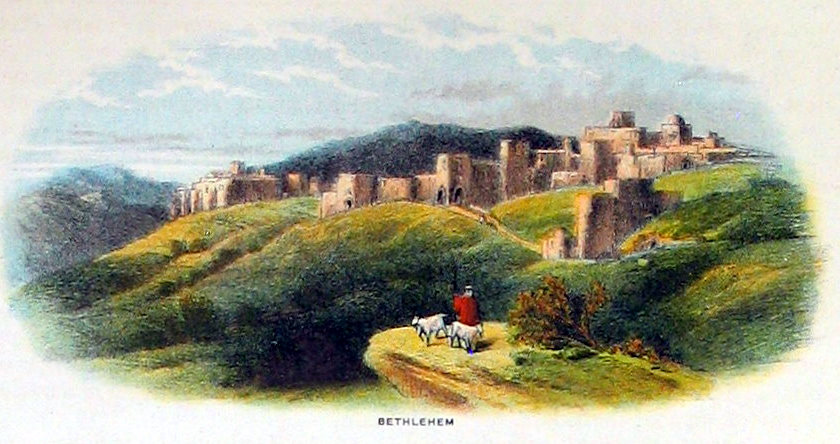
The illustration showing Bethlehem is from the Binns family Bible, now in the private collection of Regina L. Hunter.
Opinions expressed on this page are solely those of the author, Regina Hunter, and may or may not be shared by the sponsors or the Bible-study participants. Thanks to the Holy Spirit for any useful ideas presented here, and thanks to all the readers for their support and enthusiasm. All errors are, of course, the sole responsibility of the author.
Our Sponsors:
St. John's United Methodist Church, "Transforming Lives Through Christ."
2626 Arizona NE, Albuquerque, New Mexico 87110
St. John's Music Ministries now has a YouTube channel, bringing you free concerts and choral music. Check it out!
Traditional worship services are held Sundays at 8:15 and 11:00 a.m. in the sanctuary. Casual worship services are held Sundays at 9:30 a.m. in the Family Life Center. Jazz Vespers are held monthly on the second Saturday at 5:00 p.m. in the sanctuary. St. John's feels especially called to the worship of God and to the service of our neighbors through our music program.
This website is supported in part by the generosity of Mrs. J. Jordan.