Biblical Prayer –
Conversations with God
AbrahamGenesis 12:1:4a, 15:1-6, First listen, then act.
Genesis 18:16-33, Pray for others.
Moses
Exodus 3:1-15, Drop what you’re doing.
Exodus 4:1-18, Excuses probably won’t do you any good.
Exodus 6:1-13, 6:28-7:2, Keep going back for directions.
Exodus 17:1-7, Ask for help.
Exodus 32:1-14, Pray for others.
Numbers 11:10-17; Numbers 14:2, 11-23, 28-29, Complaints are okay, but enough is enough.
David
2 Samuel 2:1; 2 Samuel 5:19
Solomon
1 Kings 3:4-15
Random Walk in a Gallery of Religious Art, Step 16: 1 Kings 3:4-15a, The Wisdom of Solomon
More About Biblical Prayer
Copyright information, disclaimers, and sponsors
Return to homepage
Abraham
Genesis 12:1:4a, 15:1-6, First listen, then act. (8/18/08)The really great pray-ers that we see in the Bible talk to God almost the same way that you or I would talk to a trusted and respected friend. They have conversations, not monologues or debates. This week and next we will look at some conversations with God. Abraham's greatest talent was the gift of really listening to God. In both incidents we read about today, Abraham first listened, and then acted.
Personally, I can listen for about a second and a half, and then, since God normally hasn't had a chance to get a word in edgewise, I go on with my demands. My husband will be the first to tell you that I have trouble listening. If you are able to listen in silence, great – skip directly to the scripture. If not, here's what works for me: I read the Bible s-l-o-w-l-y. I discovered this while I was taking Greek. There's nothing magical about Greek, except that I can only read about 50 words a minute, tops. (In English, I read about 500 words a minute.) That gives God time to speak to me through the scripture. It doesn't much matter what scripture I'm reading. As your fellow-reader Yvonne W. says, God's word is alive, and whatever you read will apply to whatever you need. So if you aren't normally a listener, try this exercise. Read a word or phrase, and pause. Read it a couple times. Try to figure out what it means. Then go on to the next word or phrase. What is God saying to you?
Today’s Prayer: Dear God, Amen.
Genesis 18:16-33, Pray for others. (8/19/08)
Abraham was powerful in intercessory prayer in his conversations with God. Now, skeptics have asked, if God is omniscient and omnipotent and benevolent, why should we believe that intercessory prayer is either needed or useful? We can't tell God anything he doesn't know, we can't enable him to do anything, and he clearly wants to benefit others. That seems to me to be a good question with a logical basis. The best answer, I think, comes from Blaise Pascal, a French mathematician and philosopher, who said in his Pensees that God established prayer to give his creatures "the dignity of causality." That idea is certainly supported by today's passage (vss. 17-19). Whatever God's reason is, I can tell you two things for sure: scripture tells us to pray for others, and intercessory prayer is efficacious.
Speaking of dignity, vs. 22 is one of the 18 or so "emendations of the scribes." It is well accepted among Jewish scholars that the text originally said, "the Lord stood before Abraham." "Standing before someone" implies that the person doing the standing is serving or honoring the other person. This was deemed to impugn the dignity of God, so the very earliest scribes changed it. The changes were made so early that we don't even have copies of the original unemended texts; however, the original texts are preserved in the List of Emendations. All but one of the changes protect the dignity of God; one protects the dignity of Moses. All of the emendations are tiny – a change in one or two letters or an alteration of word order, as we see today.
Today’s Prayer: Dear God, I ask your special blessing on my fellow readers. Please heal those who are sick, comfort those who mourn, and strengthen those who have reached the limit of their own endurance. Enlighten us all. Amen.
Moses
Exodus 3:1-15, Drop what you’re doing. (8/20/08)I believe more conversations between Moses and God are recorded in the Bible than between any other person and God. If Abraham's talent was listening, Moses' talent was to stop what he was doing and take time to talk with God. We often concentrate on the bush – it was burning, so who wouldn't go aside to see it? Well, me. I'm busy. I have work to do. I have my list. I have my schedule. I mean, I even have a list for my husband and son! I don't have time for a burning bush. Moses also had a job and a family and a schedule, but when God spoke to him, he dropped everything to be part of the conversation.
Maybe I could do that. I'll put it on my list.
Today’s Prayer: Dear God, cure me of busy-ness so that I can be about your business. Amen.
Exodus 4:1-18, Excuses probably won’t do you any good. (8/21/08)
Back in 1979, my pastor, the late Rev. Dr. Bob Templeton, started talking every Sunday about the Bethel study. Every Sunday, he talked about the commitment and the time it would take for the first group of teacher trainees. Every single Sunday, I turned to my friend Dwight in the choir and said, "I'm not going to do that." I had lots of good reasons. I had just gotten out of grad school, and I was tired of studying. I had two tiny boys and a job, and I was just tired. I sang in the choir, played in the bell choir, and was on the Stewardship Committee; I really didn't have the time for anything else. Fortunately, God wasn't interested in my excuses. After several months of this, I discovered myself talking to Bob and signing up for the course. I find that when I'm making a lot of excuses, I'm deep into a conversation with God that I didn't even know was happening.
Today’s Prayer: Dear God, I know I make excuses. Help me see them for what they are. Help me use them to figure out what I should be doing. Amen.
Exodus 6:1-13, 6:28-7:2, Keep going back for directions. (8/22/08)
How often have you started some project or other and then just kept struggling with it when it wasn't going right? As we saw yesterday, Moses had doubts that anyone would listen to him. It turned out that his doubts had a good foundation, and people didn't listen to him. But his great talent was to take time out to talk to God. He kept going back for instructions and advice. This is what the business world calls "course correction." It's easier to correct your course of action a little bit here and there early in the project than to bail it out of a disaster at the end. Talk your life over with God frequently to get instructions and advice. That way you can make little, painless corrections early and avoid the big, painful corrections later on.
Today’s Prayer: Dear God, guide me today in correcting the things that get in the way of doing your work. Amen.
Exodus 17:1-7, Ask for help. (8/25/08)
Have you ever done your best to help someone, only to end up as the object of anger and resentment? As the wife of a retired pastor, I can assure you that this describes the daily life of church leaders. Almost no matter what they do, somebody is going to be dissatisfied. The best a church leader can do is to try to present Christian behavior and teaching and to hope that most of the congregation will model them most of the time.
Moses had the same problem. He gave up a lucrative and respected job as a shepherd in order to lead the children of Israel out of slavery and back to God. Did they say, "Good job, Moses, and thanks!"? No. As hard as this is to believe, they said, "We were better off as slaves in Egypt, and by the way, we're about to die of thirst and it's all your fault." Moses did what any sensible person would do: he took the problem to God. When you have a problem that you cannot solve on your own, ask for help.
Today’s Prayer: Dear God, Help my pastor to stay whole and sound. Give my pastor strength to serve you and us. Help my pastor grow in grace and wisdom in your service. Help our staff and give them energy to do your work. Help me to be a supporter, not a detractor. Amen.
Exodus 32:1-14, Pray for others. (8/26/08)
Do you and your spouse, or any other relative, ever play the game "My Son Your Son"? Here are the rules:
- 1. Any child who does well is mine.
2. Any child who does poorly is yours.
3. Any child who is flakey for a prolonged period belongs to mom, whether that is me or you.
Today’s Prayer: Dear God, please don't stop loving your people, even when that's what we deserve. I especially pray for ... and for myself. Soften our hearts so that we will turn back to you. Amen.
Numbers 11:10-17; Numbers 14:2, 11-23, 28-29, Complaints are okay, but enough is enough. (8/27/08)
My father-in-law's favorite Bible verse was "God helps those who help themselves." Actually, this well-known "verse" is not found anywhere in the Bible. The whole point of the Bible is that God helps us because we can't help ourselves. Nevertheless, when God is helping you, He expects you to be at least minimally cooperative.
Moses complained to God, but he had a legitimate beef. God had appointed him to lead the people out of Egypt, and he was doing the best he could, but he was exhausted and without resources. God decided that Moses had a point, and He appointed a bunch of helpers for him (11:16-17). The children of Israel also complained to God, but eventually they no longer had good grounds for complaint. God had taken them out of slavery, stayed with them day and night, fed them, clothed them, and gave them Moses, Aaron, and Miriam to lead them. Far from being grateful, they whined that they were better off as slaves in Egypt. After this went on for quite some time (14:11), God had had enough. The people were convinced that they were going to die in the desert, and they wouldn't turn a hand to help support themselves, so fine, God said, they could die in the desert! He would arrange it! Moses, always ready to pray for the children of Israel, managed to talk God into letting them die of natural causes.
The point is this. Complain to God; He can take it. But when God hears your complaints and gives you a solution to the problem, it's time to shut up, get up, and head out of the desert.
Today’s Prayer: Dear God, I've got some problems. I know you've got solutions. Help me to recognize your solutions and use them in my life for your glory. Amen.
David
2 Samuel 2:1; 2 Samuel 5:19 (8/28/08)The Sunday School class that I'm in often comments that it's difficult to get explicit guidance from God about what He wants us to do. I suspect there are two reasons for this. First, a lot of the answers are already in the book, and God probably figures that if we won't open His letter, we won't take His phone call, either. Second, a lot of our requests fall into the category of "Should I buy a red sports car or a blue sports car?" Maybe God wants us to buy a four-door sedan. Or a camel. Here's John Wesley's comment on today's first verse:
- "David begins at the right end, and lays his foundation in God's counsel and assistance. He asked not whether he should take the kingdom; for that was appointed before; and he would not offend God, nor dishonour his ordinance with unnecessary enquiries; but only where he should enter upon it; whether in Judah, as he supposed, because of his relation to that tribe, and his interest in it; or in some other tribe: for he doth not limit God, but resolves exactly to follow his counsels." (emphasis added)
Solomon
1 Kings 3:4-15 (8/29/08)A man was walking along the beach and found a bottle. When he rubbed it, a genie appeared and offered to grant him a wish. The man said, "I want to go to Hawaii, but I get seasick. Build me a bridge!" The genie said, "Are you kidding? Think of the concrete, the rebar, the asphalt! Make a different wish." The man thought it over and said, "I want to understand women." After a moment, the genie responded, "Two lanes or four?"
Now here is an important thing: exactly the same joke is told with God in place of the genie! Look it up; you'll find it in both versions. All too often, we pray with the idea that God is a genie, compelled to grant our wishes just because we say abracadabra – I mean, amen – at the end.
In most genie stories, the person asks for health, wealth, and power, not a bridge to Hawaii. When God offered Solomon the chance to make a wish, God expected him to ask for health, wealth, and power (vs. 3:11). Instead, Solomon asked for discernment, and God gave him that – and health, wealth, and power to boot. He needed all these gifts if he was going to do a good job of ruling God's people.
Today’s Prayer: Dear God, Give me whatever you think will best equip me to serve you. Amen.
Random Walk in a Gallery of Religious Art, Step 16: 1 Kings 3:4-15a, The Wisdom of Solomon (3/23/15)
|
God was pleased with Solomon, not because he offered 1000 burnt offerings, but because he admitted that he was in over his head and needed God’s help. God gave him the wisdom he asked for, and in addition God gave him wealth and power. The best-known example of Solomon’s wisdom, of course, is the way he determined which of the two women who came to him was the real mom. Gustave Doré shows the dramatic moment when Solomon stands to give his decision. I’m interested in the two women. The real mom is frantic. She throws herself on the swordsman to physically prevent him from harming the baby. The fake mom, in contrast, is perfectly calm, and she’s not even looking at the baby. I like the way Doré has rendered her as the darkest of the prominent characters, to suit her dark personality. Previous Step. Next Step. |
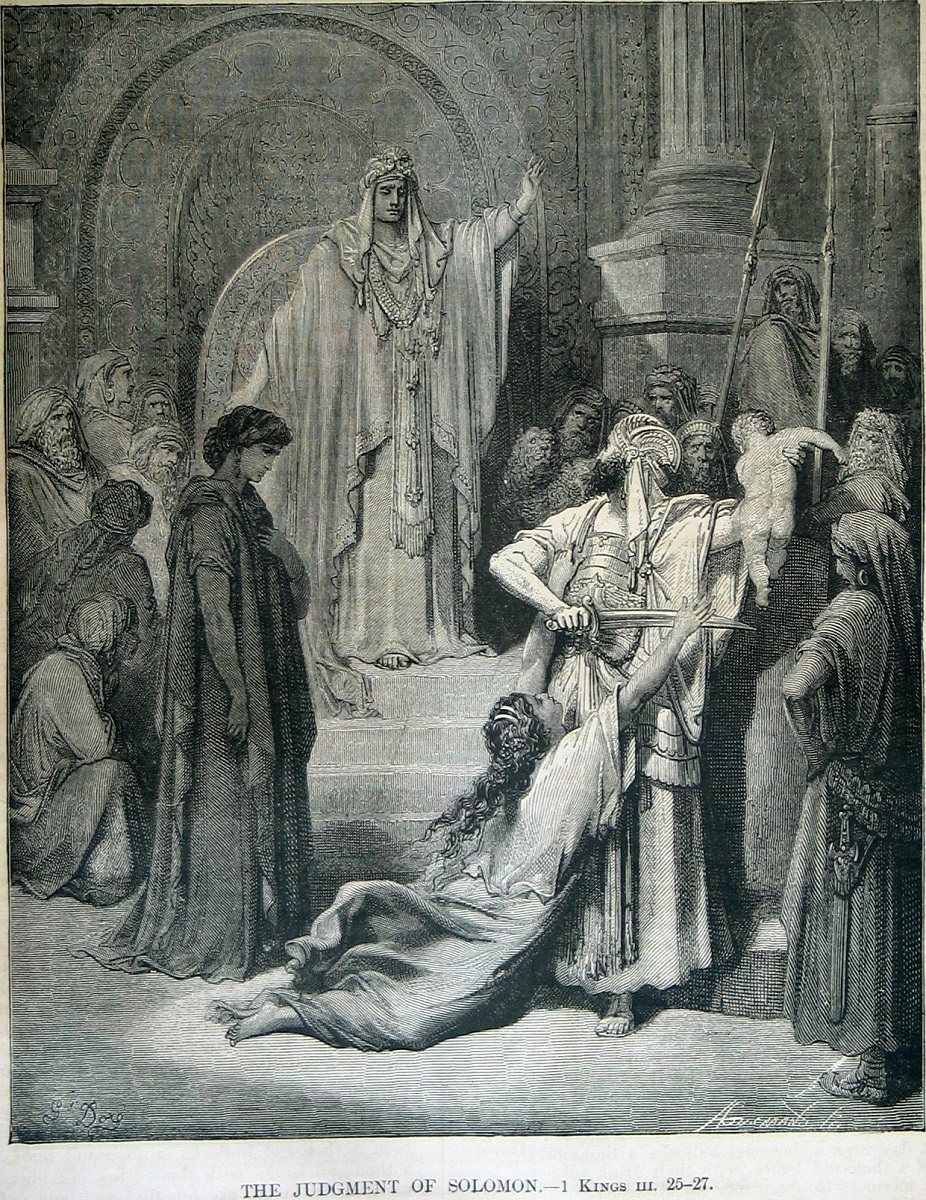 "The Judgment of Solomon" from the Gartin family Bible, now in the private collection of Regina Hunter. |
More About Biblical Prayer
The Purpose of Prayer
Conversations with God – Abraham, Moses, David and Solomon
When God Speaks
God promises to answer all prayers…
The disciples talk about prayer.
How to Pray
Copyright 2008, 2011, 2015, 2016, 2021 by Regina L. Hunter. All rights reserved.
Opinions expressed on this page are solely those of the author, Regina Hunter, and may or may not be shared by the sponsors or the Bible-study participants. Thanks to the Holy Spirit for any useful ideas presented here, and thanks to all the readers for their support and enthusiasm. All errors are, of course, the sole responsibility of the author.
Our Sponsors:
St. John's United Methodist Church, "Transforming Lives Through Christ."
2626 Arizona NE, Albuquerque, New Mexico 87110
St. John's Music Ministries now has a YouTube channel, bringing you free concerts and choral music. Check it out!
Traditional worship services are held Sundays at 8:15 and 11:00 a.m. in the sanctuary. Casual worship services are held Sundays at 9:30 a.m. in the Family Life Center. Jazz Vespers are held monthly on the second Saturday at 5:00 p.m. in the sanctuary. St. John's feels especially called to the worship of God and to the service of our neighbors through our music program.
This website is supported in part by the generosity of Mrs. J. Jordan.