Part 1

Joshua Fit the Battle of ... Ai?

Exodus 17:8-16, 24:1-18, Joshua first appears as an adult, like most people in the Bible

Exodus 32:1-19, Joshua alerts Moses to the noise in the camp

Exodus 33:1-17, Joshua stays in the tabernacle when Moses has other business

Numbers 11:10-30, Joshua is jealous on behalf of Moses

Numbers 13:1-3, 6, 8, 16-33, Joshua, Caleb, and 10 others spy out the land

Numbers 14:1-24, 30, 32-33, 38, Joshua and Caleb will be allowed to go into the Promised Land


Numbers 26:63-65, 27:15-23, 32:10-12, 32:25-29, 34:16-18, Joshua is commissioned and assigned various duties

Deuteronomy 1:34-39, 3:21-28, 31:1-8, Moses finally accepts that it will be Joshua, not he, who leads Israel into Canaan

Deuteronomy 32:44-47, 34:1-12, Joshua becomes the leader upon the death of Moses

Joshua 1:1-18, God speaks to Joshua; Joshua reminds 2 1/2 tribes of their deal with Moses

Joshua 2:1-24; Matthew 1:5, Joshua sends spies into Jericho


Joshua 3:1-17, Israel crosses the Jordan

Joshua 4:1-24, Memorial stones are gathered from the river

Joshua 5:1-9, All the men and boys born in the wilderness are circumcised

Joshua 5:10-15, The Israelites celebrate the Passover in Canaan

Joshua 6:1-27, Joshua fit the battle of Jericho


Joshua 7:1-26, The battle of Ai goes badly

Joshua 8:1-17, Joshua takes another run at Ai and sets up an ambush

Joshua 8:18-35, After the defeat of Ai, Joshua reviews the law with the people

Joshua 9:1-27, Alarmed, the Gibeonites make a tricky treaty with Israel

Joshua 10:1-21, Five southern cities gang up on Gibeon, but Joshua defends them


More of Joshua Fit the Battle of ... Ai?

Copyright information, disclaimers, and sponsors
Return to homepage
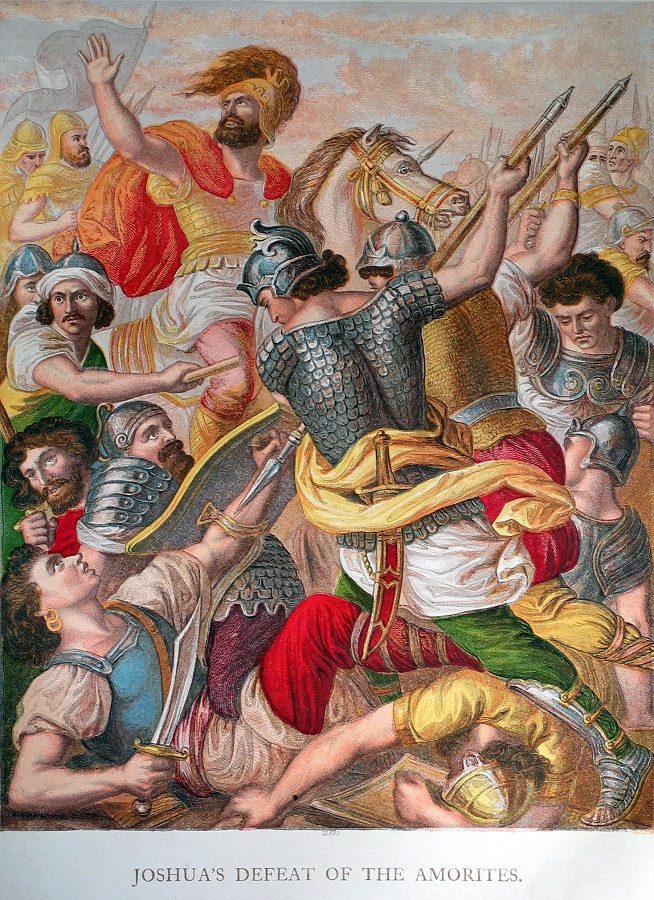

Illustration of Joshua's Defeat of the Amorites.
Joshua's Defeat of the Amorites,
from the Binns family Bible,
now in the private collection of Regina L. Hunter.
Click to enlarge.

Exodus 17:8-16, 24:1-18, Joshua first appears as an adult, like most people in the Bible (09/29/25)

Today we start a new study on the book of Joshua. When I sent the notice for publication in the church newsletter, the title (and I went back and checked this) was "Joshua Fit the Battle of... Ai?" When I got the newsletter, it had been published as "Joshua Fit the Battle of... AI?" Read the Bible for yourself, folks, and don't take my word or your church newsletter's word for what's in there. If I can help you better understand it, great, but read for yourself. These days, especially don't take AI's word! AI just believes whatever it's told, so if a silly story about folded napkins gets popular, that's what AI will tell you. Ai was Joshua's battle; AI is ours. Just remember that you're a lot smarter than AI.

We all know that Joshua fit the battle of Jericho,* but he fit numerous other battles as well, allocated land to the tribes, and led the children of Israel to renew their covenant with God. In the words of the spiritual, "He never stopped his workin', O Lord, Until the work was done." We first meet Joshua way back in Exodus, when he was a warrior and the assistant of Moses. He remained an important figure throughout the time in the wilderness, and at the end of Deuteronomy he was commissioned to replace Moses as the leader of the twelve tribes. When Joshua led the people across the Jordan and fought the battle of Jericho, the real work had just begun.

* Note to non-American readers: "fit" is an American dialectical form of "fought."

Exodus 32:1-19, Joshua alerts Moses to the noise in the camp (09/30/25)

This part of Exodus is really talking about God and Moses, and I've never been 100% clear about Joshua's whereabouts. Back in Exodus 24:2, God says, "You alone, and none of the others, are to come near me." Then in vs. 13, Moses and Joshua get ready, Moses begins to go up, and he tells the 70 leaders, "Wait here in the camp for us until we come back." After Moses has been gone a long time, and the people get restless and Aaron makes a golden calf, clearly in the camp. God notices this and is about to do some righteous smiting when Moses talks him out of it. As Moses is going down, Joshua hears the party going on, but he thinks it's a battle, so clearly he's not in the camp. He alerts Moses. So it's my impression that Joshua went partway up the mountain with Moses. If you or your pastor or commentary have a different impression, that's fine.

I love the continued "your people (not mine!) that you brought out of Egypt" conversation between God and Moses.

Exodus 33:1-17, Joshua stays in the tabernacle when Moses has other business (10/01/25)

As we've seen, Joshua didn't just appear out of nowhere, even though he was the son of Nun (MWAHAHahahaha!). Moses is grooming him for leadership well before the Israelites get to the Promised Land. Whenever Moses has to leave the Tent of the Presence, Joshua stays to keep an eye on things until Moses returns.

Another important aspect of this text is the conversation about whether God is going to go with them. Moses says, "I'll go if you go," and God answers, "Okay, I'll go with you." At that time, gods were tied to one place. No Egyptian would expect the god of the Nile, for example, to have any presence or power outside the Nile Valley. Moses and the people know God is at Mt. Sinai, but when they go off into the wilderness and thence into Palestine? Even Moses isn't sure about that. So what if they get into the wilderness and some other god takes offense? That would be bad news. Remember that a only few months before this, the Israelites didn't even know the name of their own God (Exodus 3:13-15). The model they're working from is that gods are attached to a certain place, and you can see them. As a sign that God is with them, there's a pillar of cloud over the Tent. The cloud is not God, but it's a sign given to them that God is present. It's one thing to accept in theory that your God can move around, but it's another step past that to be assured that your God is actually doing it. The idea that God can and will go with them is both novel and good news.

Numbers 11:10-30, Joshua is jealous on behalf of Moses (10/02/25)

My favorite parts of the time in the wilderness are the conversations between God and Moses. The people are basically a bunch of lazy whiners, and Moses says to God, "I can't do this by myself! Am I their mom?? If you aren't going to help, just kill me now." God says, "Fine, we can delegate some of the work to others." The delegates in front of the Tent of the Presence begin to prophesy, a sign of God's spirit upon them, but two have remained behind in the camp, and they begin to prophesy there. Joshua indignantly says the Moses should stop them, which reminds me a lot of John and James in Luke 9:49, and Moses' response is similar to that of Jesus in Luke 9:50. Remember, people can be doing the work of the kingdom even if it's not exactly the way I would do it.

Numbers 13:1-3, 6, 8, 16-33, Joshua, Caleb, and 10 others spy out the land (10/03/25)

The children of Israel have made it almost to the borders of the land promised to Abraham. Moses chooses one man from each tribe to go and spy out the land. One is Caleb of the tribe of Judah (a name to remember), and one is Joshua. They spend about a month, and they discover that the land and its produce are good, but the cities are fortified, and the people are tall. Ten of the spies want no part of any invasion, but Caleb says, "No, we can do this! Let's go!" I've always had the impression that Joshua may be a leader, but Caleb is the leader.

Numbers 14:1-24, 30, 32-33, 38, Joshua and Caleb will be allowed to go into the Promised Land (10/06/25)

After ten of the spies talk about walled cities and giants, the people at large decide they just want to pack it in and go back to Egypt. Apparently, they've forgotten all about gathering bits of straw to make bricks and about having their baby boys killed. "Waily! waily! We're all going to die!" they say.

God has had enough and is about to kill them all and start over with Moses, but again Moses talks him out of it. God says, "Okay, but you're convinced that you're going to die in the desert? Fine! Die in the desert! Except Caleb and Joshua. I'll take them and all your kids into the promised land after the rest of you are dead." This is why they spent 40 years - a generation - wandering around in a desert that it took them a month or two to cross in the first place.

Numbers 26:63-65, 27:15-23, 32:10-12, 32:25-29, 34:16-18, Joshua is commissioned and assigned various duties (10/07/25)

After roughly 40 years of wandering around in a patch of land about the size of West Virginia (but much flatter) or Latvia (but warmer), the Israelites have arrived on the plains east of the Jordan River. They take a census, which shows that all the adult men who came out of Egypt except for Caleb, Joshua, Moses, and Eleazar have died. (Eleazar could have been a child at the time of the Exodus; I'm not sure.) Now it's time to enter the promised land, but God has already told Moses that he doesn't get to go along. Eleazar has already taken Aaron's place after the death of the latter (Deuteronomy 10:6). Now God tells Moses to commission Joshua to take over leadership.

Now, in the middle of Numbers 32, which we aren't reading today, we see that when the Israelites get to the east side of the Jordan, two and a half tribes - Reuben, Gad, and half of Manasseh - decide it's good cattle country, and they want it for their inheritance. Moses says, "You know, if you stay back here out of the fight, God's going to be angry. But if you go over and fight with the other tribes, then you can come back here. How's that?" And they said, "Sounds good! It's a deal!"

Deuteronomy 1:34-39, 3:21-28, 31:1-8, Moses finally accepts that it will be Joshua, not he, who leads Israel into Canaan (10/08/25)

The very first sin, still common today, was direct and informed disobedience to the will of God (Genesis 3:2-3). The next sin, also still common today, was to blame somebody else (Genesis 3:12-13). There's some debate on what Moses did to make the LORD angry with him - strike the rock when he was told to speak to it? take credit for producing the water instead of giving the credit to God? something else? (Numbers 20:8-12) - however, it's pretty clear that toward the end of his life he commits the sin of blaming somebody else, as we see today in Deuteronomy 1:37, 3:26. He's resigned, though, and turns leadership over to Joshua.

Deuteronomy 32:44-47, 34:1-12, Joshua becomes the leader upon the death of Moses (10/09/25)

Joshua continues to act as Moses' second right up until the death of Moses, at which time leadership passes to Joshua.

Joshua 1:1-18, God speaks to Joshua; Joshua reminds 2 1/2 tribes of their deal with Moses (10/10/25)

Moses has died, and Joshua is on his own. God assures Joshua that he will be with him (as long as he obeys the Law). Joshua must be acting the teensiest bit nervous, because both God and the people tell him at least a dozen times, "Be strong! Be courageous!" Anyway, they're about to cross the Jordan, and Joshua reminds Reuben, Gad, and half of Manasseh that in exchange for taking their inheritance on the east side on the Jordan, they have agreed to act as the shock troops for the invasion. They answer, "Right, you got it. Just be strong and courageous!"

Joshua 2:1-24; Matthew 1:5, Joshua sends spies into Jericho (10/13/25)

The reputation of Joshua and the Israelites has preceded them into Canaan, and the Canaanites are terrified. When a couple of Joshua's spies enter Jericho to check it out, they stay at the house of a lady of easy virtue, Rahab. Rahab may be easy, but she isn't stupid, and she makes a deal with the spies: she'll help them escape pursuit if they in turn will help her and her family escape the destruction to come.

Rahab is one of the five women mentioned in Matthew's genealogy of Jesus, which goes in part like this:
Salmon and Rahab, Boaz and Ruth, Obed,
Jesse,
King David.
That's five generations to cover the time of the conquest, the judges, and the reign of King Saul, a total of a few hundred years. John Wesley suggests that each man was nearing 100 years of age when the son was born. Another possibility is that "father" and "mother" are used in the sense of "male ancestor" and "female ancestor," as we have seen in many places. For example, in very same passage in Matthew, Joseph is addressed as "Joseph, son of David." But take your pick.

Joshua 3:1-17, Israel crosses the Jordan (2007, 10/14/25)

How do we know that David and Todd and Clyde are qualified to be our pastors? Well, they've got credentials. They've been to seminary, they've been ordained, and they've been appointed by the Bishop. The Israelites have been led by Moses for 40 years, and now here's Joshua, who, let's face it, they've known since he was a snotty-nosed kid. He doesn't yet have the gravitas necessary for the people to follow his lead no matter where it takes them, and God recognizes this.

"Tell you what I'm gonna do," says God. "I'll work exactly the same miracle as I did for Moses when he was getting started. That will show the people that you are the man." Just as he had worked miracles to show the credentials of Moses and Aaron, he worked a miracle to show the credentials of Joshua.

Joshua 4:1-24, Memorial stones are gathered from the river (10/15/25)

We human beings are fond of setting up memorials, particularly memorial stones. You find them in cemeteries, of course, but also in parks, plazas, battlegrounds, malls, the foundations of buildings, the grounds of courthouses, and alongside roads. We want to remember people and events, and we want our children and our children's children to remember them, too. This tradition is ancient, and the crossing of the Jordan is by no means the first time the children of Israel set up a memorial, although it is the only time I can recall that they put one in the middle of a river. They also took 12 stones from the river and set up a second memorial at their first camp in the promised land.

Joshua 5:1-9, All the men and boys born in the wilderness are circumcised (10/16/25)

The Israelites have crossed the Jordan into the promised land, and now the men and boys born in the desert have to be circumcised. I don't think the Bible says anywhere why they didn't circumcise in the desert, and it also isn't clear why uncircumcision is called "the reproach of Egypt." (The ancient Egyptians apparently also practiced circumcision.) The scripture contains everything you need to know to be saved, but it also contains other stuff. If the other stuff is unclear or doesn't answer your question, it isn't necessary to know it to be saved, and it doesn't pay to be too dogmatic about it.

Back in Deuteronomy 11:30, Moses refers to Gilgal and seems to place it right about where the Israelites find it. Then in Joshua 5:9, the text seems to be saying that it's called Gilgal because of the circumcisions that took place there. It's a bit of a chicken-and-egg problem: did the name of the place trigger the pun about rolling away the reproach, or is the text anachronistic back in Deuteronomy? I don't know; I dare say nobody else does, either. But I do know this: it isn't important to salvation, so I'm not going to worry about it.

Joshua 5:10-15, The Israelites celebrate the Passover in Canaan (2007, 10/16/25)

I once asked a Jewish friend, "What's the first day of Hanukkah this year?" With a perfectly straight face he answered, "The same day it is every year." Passover is also on the same day every year (the 14th of Nissan), as is Easter (the Sunday following the Paschal Full Moon). You just have to be looking at the correct calendar. What this illustrates is that two types of sayings are always a mystery to me: In the first case, you will almost always be right if you assume that the name, whatever it is, sounds like the reason given. So in Joshua 5:9, Gilgal probably sounds like either "reproach" or "rolled away." For example, my son Edmund and his wife just named their son Edison. "Edison" sounds like "Edmund's son," which is about as close as the sound-alikes are in Hebrew.

In the second case, sometimes I'd understand better what was going on if I knew the calendar. So here's a decoding ring. Tishrei (the first month), Cheshvan, and Kislev are roughly Fall; Teves, Shevat, and Adar are roughly Winter; Nissan, Iyar, and Sivan are roughly Spring. (It's not an accident that Easter is also in the spring, because Easter and Passover are related.) Tamuz, Av, and Elul are roughly summer.

Joshua 6:1-27, Joshua fit the battle of Jericho (10/17/25)

One reason planning a new study takes me such a long time is that I get distracted by things like watching at least a dozen versions of "Joshua Fit the Battle of Jericho," some of them several times. This one was my favorite, although it was a hard choice. I believe every version was slightly different, and in fact the Golden Gate Quartet didn't always sing it the same way. In some versions I heard one phrase more clearly, and in others I heard slightly different words. It's a bit like reading more than one Bible translation so that you can better understand what the original writer was driving at.

Walled cities are difficult to get into; usually it takes a prolonged siege or siege engines (both used in the siege of Jerusalem, 2 Kings 25), or treachery from within. Joshua's method is a short siege and a sound blast.

Pay special attention to vs. 18; we'll come back to it in the next study tip.

Joshua 7:1-26, The battle of Ai goes badly (10/20/25)

Recall that in the battle of Jericho, every living person and animal other than the household of Rahab was supposed to be put to death, all gold, silver, bronze, and iron was supposed to be put into the LORD's treasury (Joshua 6:17-18), and everything else was supposed to be destroyed. Having successfully fit that battle, Joshua moves on to Ai (pronounced "eye"), unaware that Achan son of Carmi has done some looting on his own behalf. The actions of Achan have infuriated the LORD, and as a result the Israelites lose big time at Ai.

The thing I want you to notice in this reading is the idea of corporate guilt for individual sin. Achan did the looting, God is mad at and punishes the whole community, and Achan and his entire family are executed. God later outlaws the practice of punishing an entire family for one person's sin, but the fact is that when I sin, everyone around me is affected. Keep that in mind in deciding your own course of action.

Joshua 8:1-17, Joshua takes another run at Ai and sets up an ambush (10/21/25)

Another way to defeat a walled city is to get all the soldiers to come out. This is the strategy that Joshua uses during his second attack at Ai (still pronounced "eye"). (Remember that the first attack failed because of Achan's looting at Jericho.) After the men of Ai are outside the city, the main body of Joshua's troops attack them.

When you read "city," don't think about New York, L.A., or even Albuquerque, with its population of about half a million. According to Wikipedia, the Iron Age population of Palestine was probably around 400,000, and Joshua is even before that, in the Bronze Age. So the "cities" that Joshua was attacking were what we would call "small towns," and the kings were probably more like a combination of mayor and marshal (my opinion). I believe there is widespread agreement among scholars that the numbers given for troops and battle casualties in the Old Testament are highly inflated. But scholars can be wrong, so you don't have to believe that if you don't want to.

Joshua 8:18-35, After the defeat of Ai, Joshua reviews the law with the people (10/22/25)

A fellow reader writes to say that Joshua contains "one of the most upsetting readings we've done together, and the Bible contains many." True that. A lot of people are upset when they read Joshua. I could tell you some things, also true, that would make you feel better, and some that would probably make you feel worse and better at the same time. Bible study ain't for sissies. I think the thing to remember is what the Rev. Clyde Stanfield said about Revelation: "Whether you believe the book of Revelation or not, we own it. What we need to do is become intelligent and astute about how we interpret it."

With regard to the "cities," note that Ai had, providing the number isn't inflated, 12,000 people and a king. The kings in Palestine didn't play in the same league with the king of England, so don't be confused by that.

Joshua 9:1-27, Alarmed, the Gibeonites make a tricky treaty with Israel (10/23/25)

Here's one of the lighter stories among those in Joshua's conquest of Canaan. After Jericho and Ai, the Gibeonites can see the writing on the wall, and they decide that they need to make peace with the Israelites somehow. They come up with a plan: deck themselves out as if they have come from a long way off and ask for a treaty. The Israelites fall for it, but when they discover what's happened, they're a little miffed. "Fine," they say, "we'll abide by the terms of the treaty, but you have to cut wood and haul water forever." "Great," say the Gibeonites, "better to cut wood and haul water than to die!"

Many translations say in vs. 27 that Joshua made the Gibeonites "slaves" or "servants" of the Israelites; however, neither the Hebrew nor Greek of vs. 27 has any word for slave/servant/bondsman; it just says they have to cut wood and haul water. I think the idea that he made them servants must come from the Latin, which has, "And he decreed that day that they should be in the service of all the people and of the altar of the Lord, hewers of wood and carriers of water" (according to Google Translate).

Sometimes if you don't read Hebrew or Greek, you have to check the King James or Google Translate, although neither of those is perfect either. Learn Hebrew! Learn Greek! Actually, an easier course is to go to E-Sword and download a bunch of translations, especially the KJV with Strong's numbers, so you can check these things for yourself.

Joshua 10:1-21, Five southern cities gang up on Gibeon, but Joshua defends them (10/24/25)

After Gibeon makes a treaty with Israel, the Amorite kings get together to attack Gibeon. Gibeon sends to its ally Israel for relief. Israel shows up in force and defeats the combined Amorite army, and then they go to each city in turn and destroy it.

Notice that Gibeon and the five Amorite cities are all about the same size as Ai, around 12,000 inhabitants at the most. I think the most we could call them would be "city states," but I'm still going with "small towns." The area that Joshua has conquered so far isn't specifically shown on our map, but it's roughly E2, E3, F2, and F3. Gibeah, Jerusalem, Hebron, and Jarmuth are all in E3, and Lachih and Eglon are in E3.

More of Joshua Fit the Battle of ... Ai?
Joshua Fit the Battle of ... Ai? - Part 2


Opinions expressed on this page are solely those of the author, Regina Hunter, and may or may not be shared by the sponsors or the Bible-study participants.  Thanks to the Holy Spirit for any useful ideas presented here, and thanks to all the readers for their support and enthusiasm.  All errors are, of course, the sole responsibility of the author.

Our Sponsors:

St. John's United Methodist Church, "Transforming Lives Through Christ."
2626 Arizona NE, Albuquerque, New Mexico 87110

St. John's Music Ministries now has a YouTube channel, bringing you free concerts and choral music. Check it out!

Traditional worship services are held Sundays at 8:15 and 11:00 a.m. in the sanctuary.  Casual worship services are held Sundays at 9:30 a.m. in the Family Life Center.  Jazz Vespers are held monthly on the second Saturday at 5:00 p.m. in the sanctuary. St. John's feels especially called to the worship of God and to the service of our neighbors through our music program.


This website is supported in part by the generosity of Mrs. J. Jordan.