Holy Mothers (and One Unholy Grandmother) –
Women Related to Jesus
Ruth the MoabitessRuth 1:1-14, Naomi’s family.
Ruth 1:15-22, Ruth and Naomi.
Ruth 2, In the fields of Boaz.
Ruth 3:1-5, Naomi the matchmaker.
Ruth 3, Ruth and Boaz on the threshing floor.
Ruth 4, Ruth marries Boaz and becomes a great-grandmother.
Mary and Elizabeth
Random Walk in a Gallery of Religious Art, Step 69: Luke 1:39-45, Mary and Elizabeth, by Carl Heinrich Bloch
Luke 1:5-25, Elizabeth
Luke 1:26-56, Elizabeth and Mary
Luke 1:57-80, Elizabeth
Luke 2:1-24, Mary
Luke 2:25-51, Mary
John 2:1-5, Mary
Other Mothers
Copyright information, disclaimers, and sponsors
Return to homepage
Ruth the Moabitess
Ruth 1:1-14, Naomi’s family. (6/19/2008)The book of Ruth is probably the most beautiful and best-written short story in the history of literature. In the form that we have it, Ruth was almost certainly written after the Exile; remember that point, because we will come back to it in a few days. The story itself is very old, most likely contemporary with David, who, along with his family, took refuge with the king of Moab once when Saul sought to kill him (1 Samuel 22:1-4). So there’s no serious question about the truth of the story, even though it was not written down for hundreds of years after the events.
Today we see the setup. Elimelech and his wife Naomi and their sons move to Moab, where the sons marry Moabite women. Remember how important it is that the Jews not intermarry with the Gentiles? What’s going on here? Anyway, Elimelech and the two sons die. Naomi decides to return to Bethlehem. The daughters-in-law start out with her, but Naomi, who loves them, tries to send them back to their families so that they may remarry. She points out that in Bethlehem, they would have to marry brothers of their late husbands, and she is way too old to produce any sons, even if they were willing to wait. Orpah, weeping, turns back.
Ruth 1:15-22, Ruth and Naomi. (11/2/2007)
Ruth says she won’t leave Naomi, and that’s final. My mother-in-law died eight years ago today (Friday), and I still miss her very much. Would I have left my home, my parents, my country, and my gods to live with her in dark, rainy Seattle? Would I have committed to a life of widowhood to be with her? It’s not surprising that Ruth is one of the four women named in the genealogy of Jesus.
When Naomi and Ruth arrive in Bethlehem, Naomi’s old friends are amazed to see her, but Naomi says she isn’t the same woman they remember, because when she left, she had everything, and now she has nothing. What will become of these impoverished and widowed women?
Ruth 2, In the fields of Boaz. (6/20/2008)
According to the Law of Moses, a farmer or landowner could not glean his own fields. Instead, any produce that fell from the sheaves must be left on the ground for the poor, widowed, and orphaned (Leviticus 19:10, 23:22; Deuteronomy 24:21). This was one of the few resources available to the poor. Ruth decides to go gleaning so that she and Naomi will have some food in the house. She happens on the field of a wealthy man named Boaz, who shows her great kindness, not only because he is a fine person, but also because he has heard of what she has done for Naomi and of how hard she has worked. Notice how carefully the writer shows us the qualities of Boaz and Naomi, but especially of Ruth, who is loving, kind, hard-working, and polite.
Ruth 3:1-5, Naomi the matchmaker.
It was a terrible thing to be childless in Old Testament times. Not only were you deprived of the pleasure of children and grandchildren, but you had no retirement plan, no pension, no Social Security, and no health plan. Worst of all, it was a sign that God did not approve of you! So it is no wonder that Naomi busies herself with finding a husband for Ruth.
Ruth 3:6-18, Ruth and Boaz on the threshing floor. (6/23/2008)
My mom used to have a little notebook full of sayings she had copied. One of them was this short poem*:
- There’s so much good in the worst of us
And so much bad in the best of us,
That it hardly behooves any of us
To talk about the rest of us.
Ruth 4, Ruth marries Boaz and becomes a great-grandmother. (6/24/2008)
Just as Naomi predicted, Boaz immediately sets out to determine whether he or someone else will marry Ruth. He waits at the city gate – where all serious business was conducted – for the nearer relative. Inviting the man and ten witnesses to sit down, he lays out the problem: Naomi is selling her husband’s land. The other man says he will buy it. Boaz notes that the buyer must marry Ruth. Oh, no! Will Ruth marry this stranger?
Have you ever read any stories by O. Henry? The reader is led gently along the path to the obvious conclusion, and then – whammo! – there’s a twist at the end that neither the characters nor the reader have foreseen. The real punch line of the story of Ruth comes in vs. 4:17 (and in fact vss. 18-22 may well have been added later). The child that is born is the legal heir of Naomi’s husband Elimelech, and that’s what we expected all along; hence the neighbor ladies’ comment that “There is a son born to Naomi.” (Any subsequent children belong to Boaz and Ruth.) But that’s not the end of the verse!
Remember that the book of Ruth was written after the Exile. When the Jews returned to Judah after the Exile, Ezra led the people in re-instituting the Law of Moses. As a sad part of the reform, Ezra insisted that the many men who had married foreign women and brought them to Judah must now divorce them and their children (Ezra 9-10, Nehemiah 13). The writer of Ruth has led us gently along the path. Ruth, a foreign woman, has forsaken her gods and her country to come to Judah. Everyone speaks well of her. She is so respectful of her new nation that she is willing to marry someone in order to give her mother-in-law a child. And then the mighty blow descends: this foreign woman was the great-grandmother of King David! The unspoken question is: And now you want us to divorce our wives who have left their homes and families to come to Judah?
* Which turns out to be by Edward W. Hoch (1849 - 1925).
Mary and Elizabeth
Random Walk in a Gallery of Religious Art, Step 69: Luke 1:39-45, Mary and Elizabeth, by Carl Heinrich Bloch (9/4/15)|
Years ago, at a baby shower for my daughter-in-law, two surprise visitors from far out of town were waiting for her when she arrived. She threw up her hands and shrieked with joy to see her parents! When an out-of-town relative or friend comes to my door unexpectedly, I typically throw up my hands and shriek “DAVID!!!! ” (or whatever name is appropriate – ha!). So this painting of Mary and Elizabeth, by Carl Heinrich Bloch, really speaks my language. Elizabeth had no warning that Mary was coming, and both she and her unborn child John were overjoyed. Previous Step. Next Step. |
Luke 1:5-25, Elizabeth (7/24/2008)
It’s entirely possible that there is nothing new to say or think about Mary and Elizabeth. So probably we will just review some ideas that we have thought about before. Elizabeth was from the tribe of Levi and the family of Aaron. All the Temple workers came from the tribe of Levi, and all the priests came from the part of Levi that was the family of Aaron. We know she married within the “family,” because her husband Zechariah was a priest. This doesn’t necessarily mean they were closely related – only that both descended from Aaron.
Elizabeth and her husband had no children, and she was called barren. Barrenness was always considered to be the woman’s fault, because they didn’t have a good grasp of physiology and genetics in ancient times. When it was Zechariah’s turn to serve in the Temple, God sent Gabriel to announce the forthcoming birth of John, whom we know as John the Baptist. If Gabriel comes to you with a message, my advice is that you don’t give him any backtalk, because he can be a bit short-tempered.
Luke 1:26-56, Elizabeth and Mary (7/25/2008)
Gabriel was a lot nicer to Mary than he was to Zechariah. When Zechariah questioned the message, Gabriel made him mute for 9 months. When Mary questioned the message, he just gave her an answer. I read a commentary once that said, “Mary’s surprise comes as a surprise to us.” He pointed out that she was betrothed, which was pretty close to being married (the man had to get a divorce if he decided not to get married, and the woman was a widow if he died before the wedding). Presumably she expected to have children. So why did she ask, “How am I going to have a child, being a virgin”? Well, presumably the regular way after she was married, just like Sarah, Samson’s mother, and Elizabeth, all of whom found out from an angel that they would have a child.
I’ve read or heard this story at least once a year for practically my entire life, and it never occurred to me before I read that that her question is decidedly odd. Now, the commenter did not have an explanation for her question, and I don’t have one either. The main reason I’m telling you this is that it pays to think about the scriptures you’ve heard all your life. Usually if you think about them and decide something is odd, there is a fairly standard explanation. And even when there isn’t, we, like Mary, can try to discern what kind of message it might be.
Luke 1:57-80, Elizabeth (7/28/2008)
You know that our family does a lot of genealogy. Genealogists know that given names tend to run in families. (They also know that you never can tell. You would think “Minitree Jones” absolutely had to be named after an uncle, but you would be wrong – there were Minitrees everywhere in that county!) Apparently the custom of naming children after relatives is very old. When it came time to name Elizabeth and Zechariah’s baby, she decided to call him “John.” The neighbors’ reaction was that no one in her family had that name, so they decided to ask Zechariah. Notice the amusing thing: he could hear fine, he just couldn’t talk. Nevertheless, they made signs to him. (He was probably annoyed, just like any handicapped person today would be under the same circumstances.) Much to their surprise, he wrote a note to say that the baby’s name was John. Immediately the binding put on him by Gabriel was lifted, and he prophesied that Elizabeth’s baby would be a prophet of the Lord.
Luke 2:25-51, Mary (7/30/2008)
It’s fun to talk about your kids with other parents, but the downside is that you have to listen to them talk about their kids, too. This is why I used to love Parent/Teacher Conferences. I could talk for 30 minutes with someone who was interested only in discussing my child. So I’m pretty confident that Mary and Joseph were all ears when they, poor as they were, came to the holy Temple in the Big City and discovered that a couple of people there wanted to talk about their baby. Furthermore, I can still quote some of the things that my children and grandchildren said when they were little. It’s easy for me to imagine Luke sitting and listening to Mary as she told him exactly what people said about her baby, and exactly what her little boy had said to her. By the way, Luke emphasizes the Temple more heavily than the other gospel writers, so it’s not surprising that he alone reports the events we read about today.
John 2:1-5, 12; Mark 3:31-35, 6:1-3; John 19:25-27; Acts 1:13-14, Mary (7/31/2008)
There’s an email going around saying that you know Jesus was a Californian because he never cut his hair, went barefoot all the time, and founded a new religion. It also gives three reasons each why Jesus was Black, Irish, Italian, female, and Jewish. The “Jewish” part is an old joke: How do you know that Jesus was Jewish? Because he went into his Father’s business, he lived at home until he was 33, and his mother thought he was God.
Obviously Mary knew that her son was no ordinary young man. At the wedding in Cana, she presents him with a problem, and even though he says he’s not going to solve it, she knows better. She tells the servants privately to do whatever Jesus tells them to do. Later, the crowds around Jesus become so great that it’s hard for her to get a chance to see him. When she and his brothers send in a message, he replies gently but firmly that he’s busy. Nevertheless, the last action of his life is to ensure that Mary has a home with John, even though she has several other sons and daughters. And, just as we learned in the joke, she, not to mention his brothers, does come to know that he is God.
- Reader Question: In John 19:25, Mary is his mother and her sister is Mary also? I’ve never noticed that before. Your thoughts?
Response: As near as I can tell from commentaries, other people have had the same reaction as you. It isn’t 100% agreed upon whether there were four women or three Marys––
Mary AND her sister AND Mary the wife of Clopas AND Mary Magdalene
or
Mary AND her sister Mary the wife of Clopas AND Mary Magdalene. This is John Wesley’s position, and it seems to me to be an accurate reflection of the Greek in John. Probably the people who think John named four women (1) couldn’t deal with sisters with the same name or (2) didn’t read Greek.
In fact, what women were named varies between Mark and Matthew on the one hand and John on the other hand. Mark says “Mary Magdalene, and Mary the mother of James the younger and of Joses, and Salome.” Matthew says “Mary Magdalene and Mary the mother of James and Joseph and the mother of the sons of Zebedee,” which makes Salome the mother of James and John the sons of Zebedee. Luke just says “the women from Galilee.” Is Mary the sister of Mary and wife of Clopas ALSO the mother of James and Joses? Who knows? And where is Mary the mother of Jesus in this account?
Now, as a genealogist, I have no trouble with two sisters of the same name. Prior to, say, our grandparents’ generation, it was reasonably common to name a child after a deceased older child. It was not unheard of to give several children the same middle name, or to use the same name as a first name for one child and a middle name for another. I’ve seen families where all the boys had the same first name and different middle names, and even older tradition.
“Mary” was a very common name in first-century Palestine, and it wouldn’t surprise me at all to learn that the girls were “Mary Elizabeth” and “Mary Anne” or some such combination. Of course, since it’s not in any book we have, there’s no way to learn it at this time.
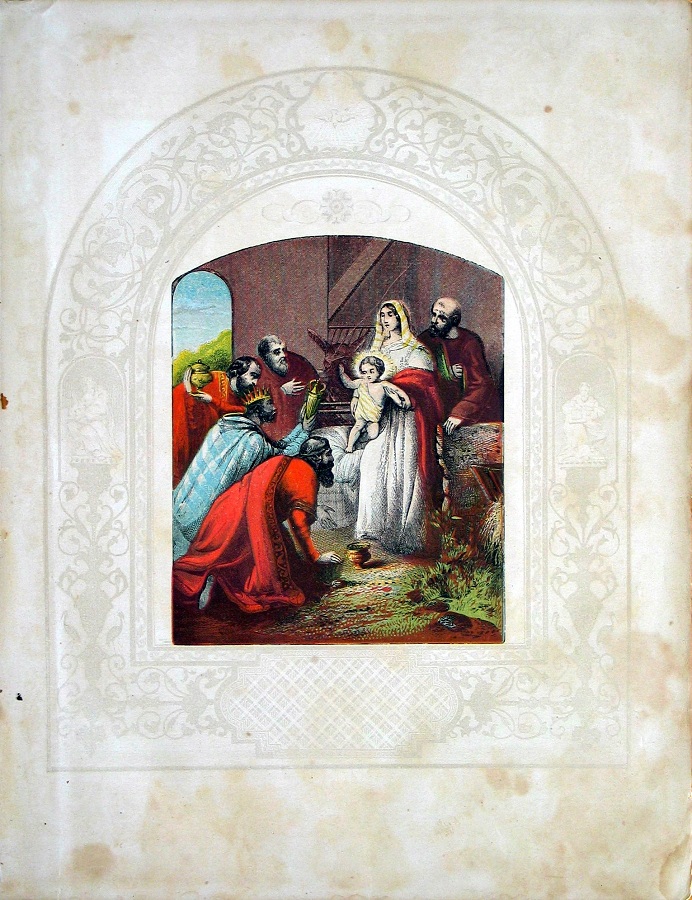
The color illustration showing the visit of the magi is from the family Bible of John O. Spencer and Lydia Bunn, married 18 Nov. 1857 in Hector, Schuyler Co., NY. A partial listing of the posted images from this Bible is given at Ducks in a Row, Inc.
Other Mothers
Founders of the Nation
Women in Charge
Other Mothers
Copyright 2007, 2008, 2011, 2012, 2015, 2021 by Regina L. Hunter. All rights reserved.
Opinions expressed on this page are solely those of the
author, Regina Hunter, and may or may not be shared by the sponsors or the
Bible-study participants. Thanks to the
Holy Spirit for any useful ideas presented here, and thanks to all the readers
for their support and enthusiasm. All
errors are, of course, the sole responsibility of the author.
Our Sponsors:
St. John's United Methodist Church, "Transforming Lives Through Christ."
2626 Arizona NE, Albuquerque, New Mexico 87110
St. John's Music Ministries now has a YouTube channel, bringing you free concerts and choral music. Check it out!
Traditional worship services are held Sundays at 8:15 and 11:00 a.m. in the sanctuary. Casual worship services are held Sundays at 9:30 a.m. in the Family Life Center. Jazz Vespers are held monthly on the second Saturday at 5:00 p.m. in the sanctuary. St. John's feels especially called to the worship of God and to the service of our neighbors through our music program.
This website is supported in part by the generosity of Mrs. J. Jordan.