Holy Mothers (and One Unholy Grandmother) –
Founders of the Nation
Sarah, Named by GodGenesis 11:27-12:20, Introduction to Abram and Sarai.
Genesis 16, Sarai gets impatient
Genesis 17, God changes Sarai’s name and promises her a child.
Genesis 18:1-15, Sarah laughs; 20:1-18, Sarah is protected.
Genesis 21:1-21, Sarah laughs again.
Genesis 23:1-20, Death of Sarah.
Rebecca Protects the Covenant
Genesis 24:1-9, Abraham sends for a nice Hebrew girl for Isaac.
Random Walk in a Gallery of Religious Art, Step 5: Genesis 24:10-27, Eliezer and Rebekah
Genesis 24:28-49, Rebecca is the one...
Genesis 24:50-67, But will she come?
Genesis 25:20-28, Rebecca has twins; 26:1-14, and is protected.
Gen. 26:34-27:17; 27:41-28:5, Rebecca ensures that Jacob marries some nice Hebrew girls.
Rachel and Leah Build the House of Israel
Genesis 29:15-35, Jacob’s two wives.
Genesis 30:1-26a, The contest.
Genesis 31:1-35, When it’s Jacob vs. Laban, no contest.
Genesis 35:16-20, 23-26; 46:15, Twelve boys and a girl.
Other Mothers
Copyright information, disclaimers, and sponsors
Return to homepage
Sarah, Named by God
Genesis 11:27-12:20, Introduction to Abram and Sarai. (5/26/08)I’ve always been puzzled that Christians and Jews tend to dismiss women as having been unimportant in the development of the faith, which is an unscriptural view (that means, “wrong”). This topical study will show you that women have held every important position available in Judeo-Christian history, with the exception of Messiah.
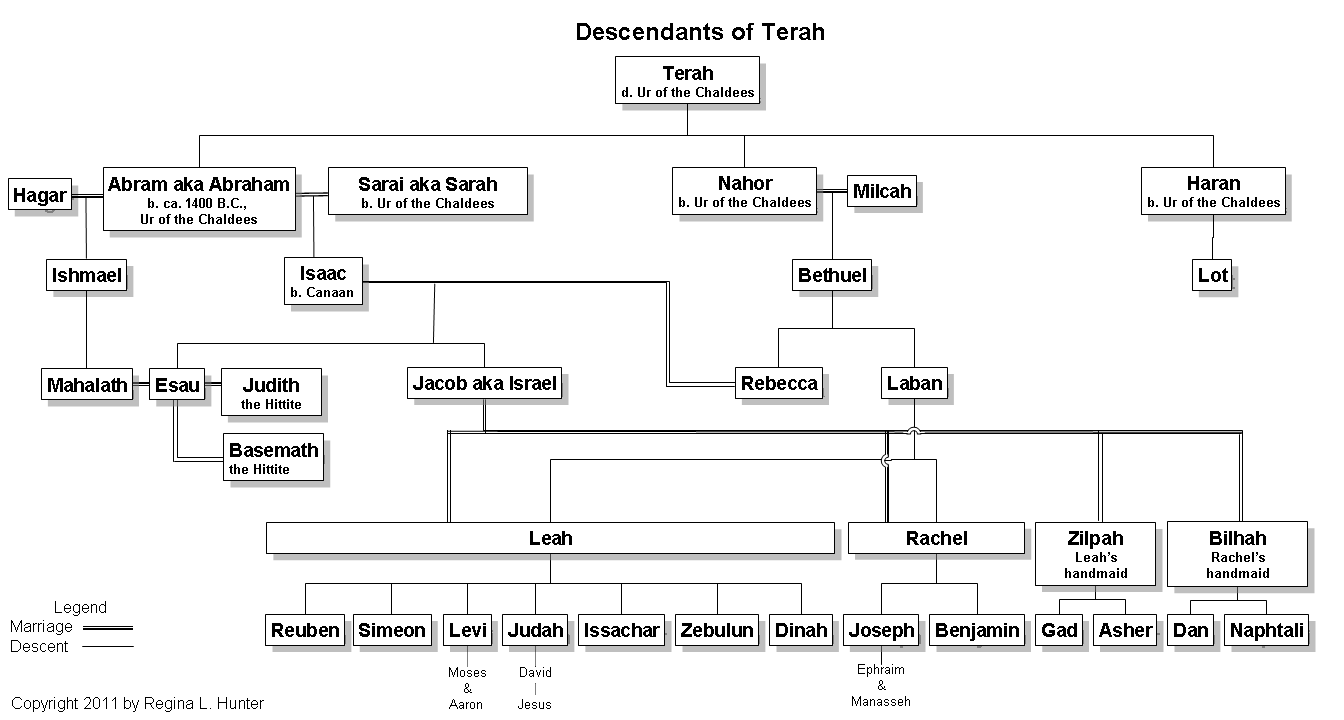
If all goes as planned, my hubby and I will leave soon on vacation. We will visit libraries, courthouses, and cemeteries. Why? Because we are going to places some of our ancestors used to live. We are almost as interested in genealogy as the writers of the Old Testament. Today we read about the ancestors of Abram and Sarai. This family is going to be important for the next three thousand years, so I’m including a chart of the family relationships. Some of this genealogy gives away the plot of what we will read later, but oh well.
Sarai was a beautiful and cultured woman who belonged to a wealthy family in Ur of the Chaldees. The location of Ur is not known for sure, but many people for a couple of millennia have identified Ur with the modern-day city of Urfa in southeastern Turkey. Another proposed site is in the Euphrates delta near the Persian Gulf, southeast of Baghdad. Wherever; it’s not important.
Sarai’s husband Abram told Pharaoh that Sarai was his sister. Later, he told someone else that she was his half-sister. Now, this offends both Jewish and Christian sensibilities. Either we whisper that Abram and Sarai were violating a Judeo-Christian sexual taboo (which didn’t exist yet, by the way), or we sneer that Abram was lying to save his own skin. There is a third possibility, however. According to National Geographic, Dec.1966, scholar E. A. Speiser discovered that sisters had rights in Ur that wives did not. A favored wife could be adopted as a sister to her husband in order to give her additional rights and prestige. So Sarai probably was Terah’s daughter and Abram’s sister, either by another wife than Abram’s mother, or by adoption.
Genesis 16, Sarai gets impatient. (5/27/08)
Infertility is a terrible grief to a woman who wants a child. Not only did Sarai want a child, but God had promised (vss. 12:2, 7) that Abram would have descendants. Naturally Sarai assumed, as his only wife, that she would bear these children, although up until this time she was barren. Now she’s getting old, and she’s getting impatient. She decides to adopt. She gives her own slave girl, Hagar, to Abram. This was an ancient form of surrogate motherhood (I am not making this up). Hagar conceives and gets to feeling real superior to her mistress Sarai – a high-born, beautiful, wealthy woman and the wife of Abram. Sarai won’t put up with this, and she beats Hagar, who runs away but later returns. The child, Ishmael, is thus Abram’s first-born son. Remember his name. He’s on the chart.
Genesis 17, God changes Sarai’s name and promises her a child. (5/28/08)
Sometimes life-changing events are accompanied by a change in name. My nephew, at about age 6, was adopted by my sister’s second husband. He realized, even in his child’s mind, that he needed a completely new name. Before, he had been called by his first name. When he was adopted, he changed his name to his middle name, and he has been called by it ever since.
God has a plan for your life. God’s plan for Sarai was that she was going to be the mother of the great nation, the descendants as numerous as stars, and the kings that were promised to Abram. Abram is skeptical (vss. 17-18) and suggests that the Covenant could go to Ishmael, but in fact, the Covenant was not promised just to Abram, it was promised to Abram and Sarai (vss. 15-16, 19; see also Romans 9:6-9, Galatians 4:22-31). God’s plan for Abram and Sarai was so vast that their old names were no longer suitable. God changed their names to Abraham, “Father of Nations,” and Sarah, “Princess.” Only a few people have had their names changed by God – in every case in conjunction with a life-changing event – and Sarah is one of them.
Genesis 18:1-15, Sarah laughs; 20:1-18, Sarah is protected. (5/29/08)
Abraham and Sarah are now well along in years. One day, some men visit Abraham and tell him that Sarah is going to have a baby. Yesterday we saw that Abraham was skeptical of this promise; today it is Sarah who laughs at the idea that she will conceive in spite of her life-long barrenness and her husband’s great age. Notice how gentle the LORD is with Abraham in reporting only that Sarah laughed because she was old!
Apparently Sarah was still quite a woman, because when they visit the town of Gerar, King Abimelech decides to put her into his harem. Abraham unwittingly contributes to this decision by describing her again as his sister. In Abraham’s eyes, this gives Sarah prestige, but in Abimelech’s eyes, it makes her available. God still has big plans for Sarah, however, and they don’t include being a harem-girl for a petty king. He protects Sarah and Abimelech, who gives Abraham a huge amount of money to show that Sarah has done nothing wrong.
Genesis 21:1-21, Sarah laughs again. (5/30/08)
Send out the birth announcements! Sarah has a baby boy! She and Abraham name him “He laughs” (Isaac), either because everyone is happy for Sarah, or to remind themselves of their initial response to God’s promise. Or both.
Now, the law was that either the children of a slave girl and the master had to inherit along with the children of the wife and the master, or the slave girl and her children had to be set free. Sarah wants no part of dividing the promises of God between Isaac and Ishmael, so she tells Abraham to set them free. Abraham feels bad about this, because after all, Ishmael is his son, too. God tells him that He will take care of Ishmael, and to give Sarah her way so that Isaac can inherit the promised blessings.
Genesis 23:1-20, Death of Sarah. (6/2/08)
Back in 1972, I was in Florence, Italy, on vacation. I only spoke 3 words of Italian, “Non parlo Italiano,” i.e., I don’t speak Italian, but after a few days I had picked up “How much?” and numbers for prices and conversions. In the marketplace I saw some beautiful skeins of angora yarn. I asked how much and, told that it was 300 lira, agreed to buy it. Apparently this was not acceptable, because I immediately got a tirade of Italian, almost none of which I understood. I kept hearing numbers. As near as I could tell, the vendor was doing both sides of the bargaining – his and mine – because I eventually got the angora for 180 lira. It was very strange.
We know more about Sarah’s death, funeral, and burial place than we do for all but a handful of the people in the Bible. All his life, Abraham was a wanderer who owned no property. When Sarah died, he wanted to buy a permanent place to bury her. His bargaining with Ephron the Hittite looks a little strange to us. Our bargaining starts with a seller’s price that’s too high and a buyer’s price that’s too low, and the two prices meet in the middle. When Abraham bargains with Ephron, the seller’s price starts out too low (free), and Abraham’s price starts out too high (“whatever you want”). Like our bargains, eventually the price meets in the middle.
Sarah was an important, beautiful, God-fearing woman, and it is no surprise that we name girls after her until this very day.
Rebecca Protects the Covenant
Genesis 24:1-9, Abraham sends for a nice Hebrew girl for Isaac. (6/3/08)You’ve heard the phrase “Abraham, Isaac, and Jacob” many times. As a matter of fact, we know a lot about Abraham, and a lot about Jacob, but little about Isaac. We see Isaac primarily in relation to his mom and dad and then in relation to his wife, Rebecca. That’s okay, because we know a lot about Rebecca.
In the United States, we get a lot of immigrants. Typically the pattern is that the immigrant generation continues to speak the old language and keep the old customs. The second generation understands the old language, keeps the old customs at holidays, and may marry some other second-generation person. The third generation doesn’t understand the old language, doesn’t care about the old customs, and marries any other American that strikes their fancy. This is called “assimilation.”
Abraham was a wanderer in the land of Canaan, where they knew nothing of Abraham’s God. It was important that Isaac not become assimilated by marrying a Canaanite woman and following the Canaanite religious customs. Abraham calls in his foreman and makes him swear to go back to the old country, to Abraham’s own people, to find a wife for Isaac. God guides the foreman directly to the family of Abraham’s nephew Bethuel, son of Nahor and Milcah (see chart), who has a kind and beautiful daughter, Rebecca.
Random Walk in a Gallery of Religious Art, Step 5: Genesis 24:10-27, Eliezer and Rebekah (3/6/15)
The mind boggles! Everybody knows that the servant who was sent by Abraham to find a wife for Isaac was his right-hand man, Eliezer, and our illustration is called “Eliezer and Rebekah.” Imagine my surprise when I read John Wesley’s note that said the servant was “Probably Eliezer of Damascus.” I reread more carefully, and sure enough, the servant’s name is not given. Read carefully for yourself, people, and don’t take my word for anything. Or the artist’s word, obviously.
I love the way Eliezer is looking at Rebekah. Can she be the one? He leans forward on his staff and stares at her intently. You can see his tension in the way the muscles and veins stand out on his arm. He has traveled far on a search for a wife for his master’s son, and it’s important that he find the right one. He has prayed for a sign from God; will this beautiful young woman be gracious enough to water his camels? Will she be related to his master’s family? Yes, on both counts. She runs to ease the thirst of the exhausted camels and men, and she is Abraham’s own great-niece, first cousin once removed to Isaac.
Previous Step. Next Step.
Genesis 24:28-49, Rebecca is the one... (6/4/08)
Abraham’s foreman prayed for guidance, and the LORD revealed that He had chosen Rebecca for Isaac. The foreman gave the girl precious gifts of gold, which immediately focused everyone’s attention. He tells his story to the rapt audience in the household of her father Bethuel and her brother Laban. Like every good story teller, he ends with the question, “What will you do about what you have heard?”
Genesis 24:50-67, But will she come? (6/5/08)
Rebecca was not chattel. Even though she was just a girl, she had certain rights. Among them were the right to receive the bulk of the bride price and the right to refuse or accept a proposed marriage. The foreman wants to take the girl and go, and Laban and Bethuel are willing, but notice that they ask Rebecca for a decision. Only when she agrees do they send her on her way, with their blessing.
Genesis 25:20-28, Rebecca has twins; 26:1-14, and is protected. (6/6/08)
My grandpa had four brothers and sisters. Grandpa was close to his sister Cecile, but he used to jokingly refer to his other, older brothers and sisters as “distant relations.” It seems like in every family, even though everyone loves everyone else, there are pairings between parent and child or between siblings that like each other better.
Rebecca bore twins to Isaac; Esau was the elder and Jacob the younger. Isaac liked Esau better than Jacob, and Rebecca liked Jacob better than Esau. Rebecca is one of the few women in the Bible – in fact, one of the few people – to whom God speaks directly. God told her while she was still pregnant that her older son would
Genesis 26:34-27:17; 27:41-28:5, Rebecca ensures that Jacob marries some nice Hebrew girls. (6/9/08)
Rebecca was a family-focused woman, and she was completely familiar with God’s promise to Abraham and Isaac. She didn’t see the appropriate qualities in Esau to allow him to inherit the “family business” of the Covenant. This is the same Esau who sold his birthright to Jacob for lunch. (Jacob gets bad press about that, but Esau is the one who valued his birthright so little that he couldn’t wait for dinner. Or make himself a sandwich, even.) Esau also married a couple of Canaanite women, which made both Rebecca and Isaac unhappy. Eventually Esau noticed that the Hittite women weren’t popular, so he married a daughter of Ishmael (see chart), whose line had already been barred from inheriting the Covenant.
When Isaac, feeling that he is in danger of dying, decides to give Esau his blessing, Rebecca is determined to get it for Jacob instead. She is the one who arranges to trick Isaac into thinking that Jacob is Esau. (Although, like mother, like son, as you well know about Jacob.) Esau is furious and threatens to kill Jacob. Rebecca, not wanting to lose both sons, goes to Isaac and says, truthfully, that the Hittite women whom Esau has married are driving her nuts. She wants Jacob to do what Isaac did – marry a nice girl from the old country. Isaac agrees, and they send Jacob not only out of harm’s way, but out of the danger of assimilation.
Rachel and Leah Build the House of Israel
Genesis 29:15-35, Jacob’s two wives. (6/10/2008)Sneakiness seems to run in this family, although one culture’s sneakiness is another culture’s uprightness, so maybe we shouldn’t be too judgmental. Jacob has been away from Isaac and Rebecca for 14 years now, and he has acquired two wives, his own double cousins (see chart).
Let me talk for a minute about love and hate. Jesus says, rather famously, that anyone who loves Him must hate his parents, spouse, and children. This seems so harsh to us that we think he must be kidding, so we ignore it. It is an idiom. In the Bible, when hate is contrasted with love, as in “Jacob loved Rachel and hated Leah,” is doesn’t mean “hate,” it means “love less,” as shown in vs. 30. So Jesus is saying that we should love him more than we love our parents, spouse, or children. That’s a lot of love.
Genesis 30:1-26a, The contest. (6/11/2008)
I don’t want to say that Leah and Rachel were competitive, but it seems to me that bearing six kids and adopting two more just to get bragging rights over your sister is a little extreme. If you want eight kids, great, go for it, but Leah and Rachel’s motive seems more related to one-upmanship than to mother love. Maybe they each wanted the lion’s share of the blessing, who knows?
Remember how Sarah gave her slave girl Hagar to Abraham so that she, Sarah, could have a child? We see clear examples of this custom in today’s reading. See especially vss. 4-6, where Rachel claims Bilhah’s baby as her own son. Apparently this custom faded over time, because all the genealogies list Zilpah and Bilhah as the mothers of the appropriate sons. The chart lists all of Jacob’s children that we know about. The 12 sons are the ancestors of the 12 tribes of Israel.
Also remember that when they say something like “Happy am I!” and call the boy “Asher,” it’s because “Asher” sounds like “happy” in Hebrew.
Genesis 31:1-35, When it’s Jacob vs. Laban, no contest. (6/12/2008)
The bride price for Leah and Rachel was seven years of labor each. We saw that Rebecca got the bulk of the bride price paid for her, but Leah and Rachel say that they didn’t benefit from the labor that Jacob paid to Laban. Leah and Rachel didn’t always get along perfectly, but when it comes to a choice between Laban and Jacob, they agreed completely that the whole family should take what was theirs and go before they lost any more.
Why Rachel steals Laban’s teraphim – often translated as household gods – is a mystery to me. However, it does give the writer the opportunity to be really insulting about idols. Rachel, who is menstruating at the time, sits on the teraphim to hide them from Laban. Menstrual blood was unclean under the Law given to Moses several hundred years later, so this is a dig at so-called gods who can’t even protect themselves from uncleanness.
Genesis 35:16-20, 23-26; 46:15, Twelve boys and a girl. (6/13/2008)
You’ve probably heard about the Twelve Tribes of Israel all your life, but now you know that the twelve ancestors were born primarily out of the sisterly rivalry of Rachel and Leah. The last son, Benjamin, was born on the way back to Canaan, shortly before the family reached Bethlehem. Jacob’s favorite wife, Rachel, died in childbirth with the youngest child. No wonder Jacob was so reluctant to part with him several years later when Joseph demanded that the boy be sent to Egypt! Our passage today summarizes Rachel and Leah’s work in building the house of Israel.
Jacob had one daughter that we know about, Dinah. You can read more about Dinah in Genesis 34, but it’s not a pretty story. Apparently there were more daughters, not named; see vs. 46:15.
Other Mothers
Women in Charge
Women Related to Jesus
Other Mothers
Copyright 2008, 2011 by Regina L. Hunter. All rights reserved.
Opinions expressed on this page are solely those of the
author, Regina Hunter, and may or may not be shared by the sponsors or the
Bible-study participants. Thanks to the
Holy Spirit for any useful ideas presented here, and thanks to all the readers
for their support and enthusiasm. All
errors are, of course, the sole responsibility of the author.
Our Sponsors:
St. John's United Methodist Church, "Transforming Lives Through Christ."
2626 Arizona NE, Albuquerque, New Mexico 87110
St. John's Music Ministries now has a YouTube channel, bringing you free concerts and choral music. Check it out!
Traditional worship services are held Sundays at 8:15 and 11:00 a.m. in the sanctuary. Casual worship services are held Sundays at 9:30 a.m. in the Family Life Center. Jazz Vespers are held monthly on the second Saturday at 5:00 p.m. in the sanctuary. St. John's feels especially called to the worship of God and to the service of our neighbors through our music program.
This website is supported in part by the generosity of Mrs. J. Jordan.