Heroes of the Faith –
The Judges: Ehud, Deborah, Gideon, and Jephthah
EhudJudges 3:12-30, Ehud Defeats the Moabites.
Deborah
Judges 4:1-10, Deborah & Barak Go to Battle.
Judges 4:11-24, Jael Kills Sisera.
Random Walk in a Gallery of Religious Art, Step 28: Judges 5:1-31, Song of Deborah
Judges 5:1-16, Deborah & Barak Distribute Praise & Blame.
Judges 5:17-31, Deborah & Barak Praise Jael.
Gideon
Judges 6:1-24, Gideon is Called.
Judges 6:25-40, Gideon Makes Sure.
Judges 7:1-15, Gideon Has Too Many Soldiers.
Judges 7:16 – 8:3, Gideon Uses Psychological Warfare.
Jephthah
Judges 10:6-18, The Ammonites Oppress Israel.
Judges 11:1-11, Jephthah Lays Down His Terms.
Judges 11:12-28, Jephthah Tries Negotiation.
Judges 11:29 – 12:7, Jephthah's Rash Vow Brings Gain & Loss.
More Heroes of the Faith
Copyright information, disclaimers, and sponsors
Return to homepage
The events in the book of Judges are cyclical. Between the return from Egypt and the selection of Saul as king, Israel had no central government. During this time, the people of Israel repeatedly fell away from God, he punished them by letting them be oppressed by one of the Canaanite kingdoms, they repented and asked God for help, he sent a judge to free them, they behaved while the judge was living, the judge died, the people of Israel fell away from God....
We know most about Ehud, Deborah, Gideon, Jephthah, and Samson.
Ehud
Judges 3:12-30, Ehud Defeats the Moabites. (3/22/10)The stories in the book of Judges would make good action movies. One of the judges we know something about is Ehud. He is the only person in the Bible described as left-handed, probably because this is the only event where handedness is critical to the story. You know - if you've ever been arrested, set off the metal detector in an airport, or watched television - that modern-day security people pat you down on both sides. Apparently King Eglon's people only patted visitors down on the left, where right-handed people would carry their swords. Left-handed Ehud carried his short sword on the right. Presumably the next Moabite king changed the procedure.
Deborah
And Man knows it! Knows, moreover, that the Woman that God gave himMust command but may not govern - shall enthral but not enslave him.
And She knows, because She warns him, and Her instincts never fail,
That the Female of Her Species is more deadly than the Male.
-- From "The Female of the Species," by Rudyard Kipling, 1911
Judges 4:1-10, Deborah & Barak Go to Battle. (2/1/2010)
During the time of the Judges, Israel had no central government. Instead, each tribe was ruled by its own elders. This was a time of ... shall we say ... mixed adherence to God's law. Whenever one or more tribes fell into serious apostasy, God allowed the people to be oppressed by one of the local Canaanite nations until they learned their lesson and repented. At that point, God would raise up a Judge, who was normally a charismatic military leader. The Judge would unite one or a few tribes and lead them in battle to throw off the oppressor. Although we know the names of 13 Judges, we only know the stories of six.
One of the Judges we know something about is Deborah. She wasn't a war fighter herself, but more of a commander-in-chief. She told Barak that he was supposed to go out and fight. Barak said he would go only if she - the actual Judge - would come with him. The Lord was initially going to let Barak defeat Sisera, but after he declined to go alone, Deborah reported that now Sisera would be delivered into the hand of a woman.
Judges 4:11-24, Jael Kills Sisera. (2/2/2010)
Long ago, but in this same galaxy, I was teaching a Bethel teacher-training class, and we were studying today's passage. I read some of it out loud to them, as follows:
-
"Jael, Heber's wife, took a tent-peg, picked up a hammer, crept up to him, and drove the peg into his skull as he lay sound asleep. His brains oozed out on the ground, his limbs twitched, and he died."
On a less exciting note, the hoorah about the 900 iron chariots arose from the fact that the Israelites were still in the Bronze Age, while many of their enemies were in the Iron Age. It was sort of like fighting nuclear weapons with tanks.
Random Walk in a Gallery of Religious Art, Step 28: Judges 5:1-31, Song of Deborah (4/8/15)
|
The Song of Deborah is a rip-roaring victory song. It praises God (1-5, 31); allocates some of the credit to Deborah (the prophetess) and Barak (the general) (6-13); congratulates the tribes that followed them (14-15, 18-23); mocks the tribes that didn’t fight (16-17); describes Jael’s critical role in the victory (24-27); and finishes with a poignant vignette of the defeated Canaanite General Sisera’s mother (28-30). Whew! So Doré’s picture of an exultant Deborah and her rapt listeners is spot on. But where on earth was that pillar? I said yesterday that it wasn’t there in David’s time; it certainly wasn’t there several hundred years earlier in Deborah’s time! And take a look at the guy in the far back on the right in each picture: same guy. HAHAhahaha! I’m really getting to like old Gustave, whom wikipedia characterizes as a “prodigy troublemaker.” Previous Step. Next Step. |

|
Judges 5:1-16, Deborah & Barak Distribute Praise & Blame. (2/3/2010)
The Song of Deborah is thought by many scholars to be the oldest piece of the Bible that we have. It's a victory song that praises God and all the tribes that followed Deborah and sneers at tribes that didn't help. (We'll read the rest of it tomorrow.) Judges had no means of forcing tribes to cooperate; they relied totally on God-given charisma to raise armies and to enforce purity of worship and compliance with their decisions about the cases brought to them. Strangely enough, the Song doesn't even mention the tribes of Judah or Simeon, but this may be because they were located too far to the south to participate.
Judges 5:17-31, Deborah & Barak Praise Jael. (2/4/2010)
Deborah and Barak continue to celebrate the tribes who fought the Canaanites and ridicule the ones that didn't. They also make special mention of two women: Jael, by whose hand Sisera died, and his mother, to whom he did not return.
The last sentence, "There was peace in Israel for about forty years," is not part of the Song of Deborah. Most of the stories of the Judges end with this or a similar statement. There is peace in the land during the tenure of the Judge, under whose charismatic guidance the people are faithful to God. Each of the judges is a hero both in the sense of being a victorious military and political leader, and in the sense of providing an example of particular faithfulness to God.
Gideon
Judges 6:1-24, Gideon is Called. (2/8/2010)What would you say if an angel came to you and said that you were about to do great things for God? My response would probably be, "Oh, right. Tell me another one." That is exactly Gideon's response. I especially like the fact that he asks for a sign, and when he gets the sign, his reaction is to moan in fear. Personally, I always pray that God will not give me a sign in the first place, because I'm confident that I wouldn't believe it, and then I'd really be in trouble. So I feel very close to Gideon; he is my favorite judge.
Judges 6:25-40, Gideon Makes Sure. (2/9/2010)
Two parts of our passage are especially interesting. First, notice that the Jews were not monotheistic during the time of the judges. It's one thing to acknowledge that other people have other gods, however, and another thing entirely to worship those gods. The Jews were actually worshipping other gods; that's why they kept getting into trouble.
Second, Gideon is not fearless - he's afraid of the reaction of his family and the other people in his town. He's not even confident - he asked for a sign from the angel, and got it, and now he asks for another sign. Getting that one, too, he asks for yet another sign, just to be absolutely sure. What Gideon is, is courageous, which means doing what you have to do even when you are afraid and lack confidence.
Judges 7:1-15, Gideon Has Too Many Soldiers. (2/10/2010)
Has it ever occurred to any of us that we might have too many resources to serve God? Too much money? Too big a building? Too many Bibles? My missionary friends report truly amazing events in the Church in third-world countries, where they have no money and no buildings, and a single Bible is a community treasure. Sometimes I think the Church in America could do with a little persecution and impoverishment to make us appreciate what God has given us and think more clearly about what we could be doing with it.
Gideon had too many resources. When he rallied the Israelites to join him in throwing off the Midianites, 32,000 men volunteered. God was concerned that if this tremendous force was successful, they would assume that they had won the battle for their freedom. God was no doubt justified in this concern. When we do some good work for the Kingdom, we usually think, "Wow! Are we great, or what?" Certainly we should be doing all we can for the Kingdom, but at least once a year, let's try to think, "Wow! God is letting us help him!"
Anyway, God told Gideon to send all but 300 of the men home, so that it would be clear that this particular victory was of God, not of man.
Judges 7:16 – 8:3, Gideon Uses Psychological Warfare. (2/11/2010)
Gideon may have been skeptical and fearful, but he was shrewd. He made the most of what he had. He had 300 men, but enough torches and trumpets for 32,000 soldiers, so he gave a trumpet and torch to every man. When it was time for the assault in the dead of the night, every man blew his trumpet and waved his torch. The Midianites were convinced that they faced a much larger force and were thrown into a panic.
Later, Gideon also shows his political shrewdness. It's easy to say, after the battle, "We wanted to fight, too!" Gideon didn't argue. He just said, "What you did was so important that it didn't even matter that you didn't fight."
Gideon's story shows that you don't have to be fearless or argumentative to be a hero for God.
Jephthah
Jephthah overcame a difficult childhood to become a leader in Israel. His position brought him both glory and grief.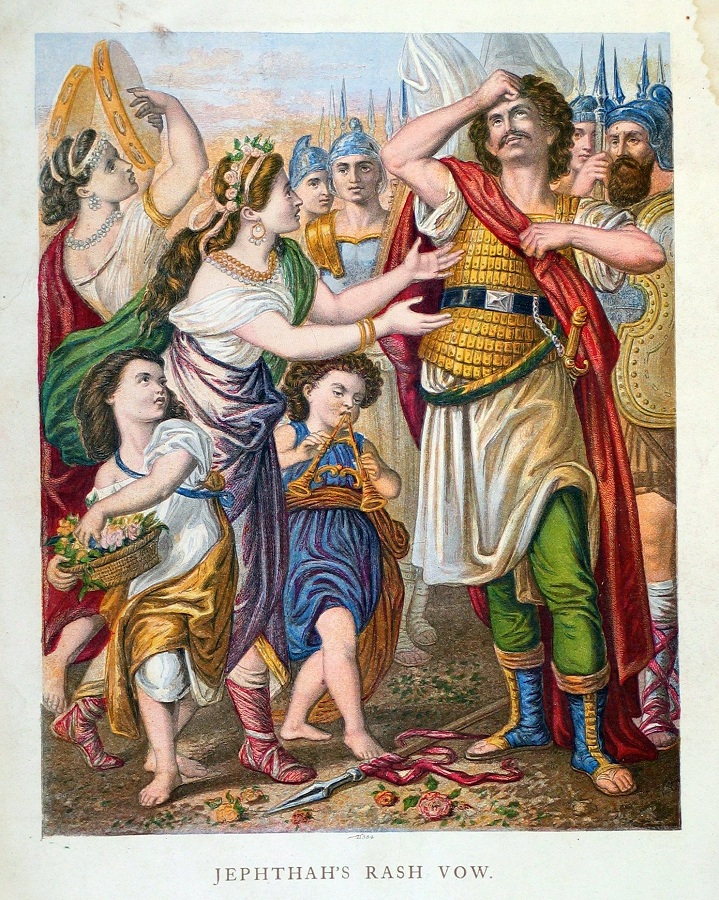
Judges 10:6-18, The Ammonites Oppress Israel. (3/23/2010)
Another judge we know something about is Jephthah. His sad story begins in the standard way: the people of Israel abandon God and are oppressed. They eventually turn back to God and ask for help. The only difference between this round and many other rounds of apostasy is that God is at first skeptical of their sincerity. He says to them, "You wanted other gods, and you got them. Why not ask them for help?" Good question, and one we should ask ourselves whenever we are tempted to abandon God.
Judges 11:1-11, Jephthah Lays Down His Terms. (3/24/2010)
The Ammonites were one of several Canaanite peoples. They worshipped a god called Milcom, about which the Bible doesn't say much except that it was an abomination. When the city fathers of Gilead are having trouble with the Ammonites, they find themselves in the embarrassing position of having to request help from that bad boy Jephthah, whom they previously ran out of town.
Judges 11:12-28, Jephthah Tries Negotiation. (2/25/2010)
Jephthah seems to have been in error in suggesting that the Ammonites worshipped Chemosh, who was actually the god of the Moabites. On the other hand, maybe he was just being insulting - "you can have the lands your god - whatever his name is - gives you, just as we have what the Lord our God has given us." The idea that a particular god, or the Lord God, is or isn't strong enough to protect his, her, or its people or lands is presented in a number of Old Testament passages.
As far as I know, at the time of the Judges, nobody was monotheistic. Certainly not the Jews or any other people inhabiting Canaan. During this period, the closest the Jews came to monotheism was that periodically they only worshipped one God, in contrast to the other Canaanite peoples, who consistently worshipped a pantheon. Chemosh, Baal, or Milcom were the most powerful gods in their respective pantheons, sort of like Zeus or Odin. It's also possible that some of these gods were actually the same one working under an alias. All the pantheons seem to have had a chief goddess with a name that varied but was usually something like "Astarte." None of them were people you would want living next door.
Judges 11:29 – 12:7, Jephthah's Rash Vow Brings Gain & Loss. (3/26/2010)
Years and years ago, our young pastor preached a sermon in which he told a little of his own history. As a young man - in college, I think - he was diagnosed as going blind. He swore to God that if his sight was spared, he would enter the ministry. He had no further loss of vision. He said, "Lord, you know I was just kidding, right?" The next thing he knew, he was in seminary. The Lord takes your vows very seriously, and so should you.
Nevertheless, Jephthah's particular vow was repugnant to God, who had spent several hundred years trying to get the Israelites to stop the practice of child sacrifice, and would spend several hundred more before He was completely successful.
More Heroes of the Faith
Copyright 2010, 2011, 2015, 2016 by Regina L. Hunter. All rights reserved.
The woodcut showing Jephthah and his daughter is from the Binns family Bible, now in the private collection of Regina L. Hunter.
Opinions expressed on this page are solely those of the author, Regina Hunter, and may or may not be shared by the sponsors or the Bible-study participants. Thanks to the Holy Spirit for any useful ideas presented here, and thanks to all the readers for their support and enthusiasm. All errors are, of course, the sole responsibility of the author.
Our Sponsors:
St. John's United Methodist Church, "Transforming Lives Through Christ."
2626 Arizona NE, Albuquerque, New Mexico 87110
St. John's Music Ministries now has a YouTube channel, bringing you free concerts and choral music. Check it out!
Traditional worship services are held Sundays at 8:15 and 11:00 a.m. in the sanctuary. Casual worship services are held Sundays at 9:30 a.m. in the Family Life Center. Jazz Vespers are held monthly on the second Saturday at 5:00 p.m. in the sanctuary. St. John's feels especially called to the worship of God and to the service of our neighbors through our music program.
This website is supported in part by the generosity of Mrs. J. Jordan.