Daily Bible Study Tips –
Comments on Jeremiah and Lamentations
|
Introduction, Jeremiah 1:4-10 Jeremiah 4:11-12, 22-28 Jeremiah 8:18-9:1 Jeremiah 26:8-16 Jeremiah 29:1, 4-7 Jeremiah 32:1-3, 5-15 Jeremiah 33:14-16 Lamentations 1:1-6 Copyright information, disclaimers, and sponsors Return to homepage |
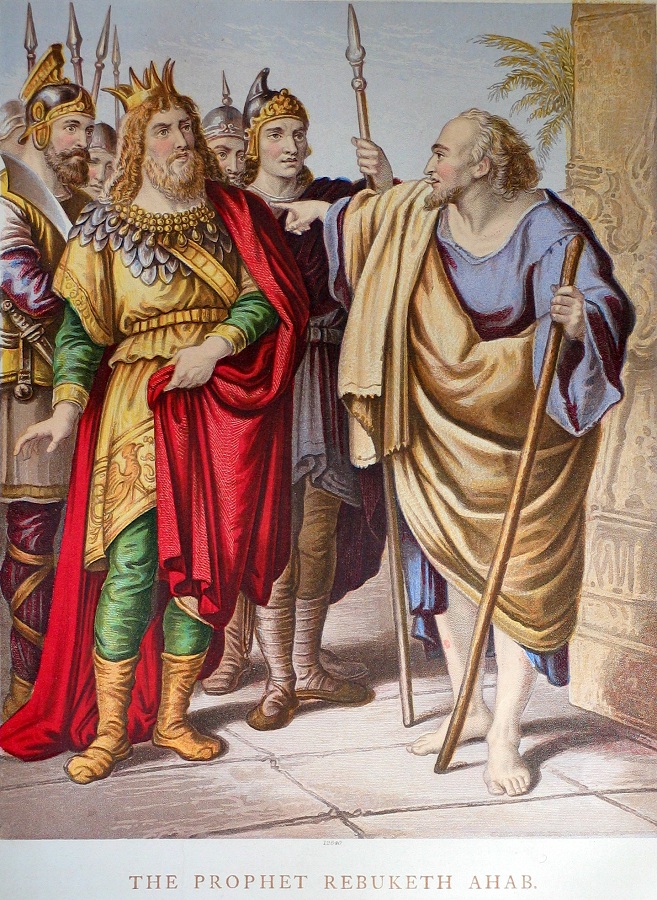 "The Prophet Rebuketh Ahab" from the Binns family Bible, now in the private collection of Regina L. Hunter. |
Jeremiah 1:4-10
Being called by God to be a prophet is awe-inspiring, humbling, more than a little frightening, and often dangerous:
- Moses: "Who am I? ... What shall I say? ... They will never believe me. ... I am slow of speech."
- Isaiah: "Woe is me! I am lost!”
- Jeremiah: "Ah, Lord God: behold, I cannot speak, for I am a child.”
- Ezekiel: After the vision in which God calls him, "For seven days I stayed with them, dumbfounded."
- Hosea: God said to him, "Go. Take a prostitute for a wife, and get children of her prostitution; for like a prostitute, this land is unfaithful to the LORD."
- Jonah: He kept quiet, but immediately bought a ticket for Tarshish (roughly equivalent to Timbuktu.)
- Daniel: Thrown into a den of lions.
- John the Baptist: Imprisoned and beheaded.
Jeremiah 4:11-12, 22-28
Jeremiah is sometimes called the "weeping prophet." My main tip is this: Never read Jeremiah or Lamentations on an overcast day. Jeremiah preached before and during the Exile of Judah in Babylon. God was very angry and disappointed about Judah's continued worship of other gods, and finally God had had enough. Most prophets give a fairly simple message: continue in your current wicked ways and die, or repent and live. Jeremiah is the only prophet I know of who is not at all sure that God will take the children of Israel back. Their sins were so many and so pervasive that Jeremiah did not promise them that they could repent and live.
Jeremiah 8:18-9:1
Both my parents smoked. They complained about the cost, the bad taste, the yellow teeth, and the difficulty of quitting. My sister and I made the same decision: not to start. We were able to learn from the previous generation's experience. God punished the northern kingdom, Israel, for its continued sins by sending the people into exile in 722 BC. More than a hundred years passed, and Israel was never restored. Did the southern kingdom, Judah, learn from Israel's experience? Unfortunately, no, and now we are down to the last days of the kingdom of Judah. The prophet Jeremiah and the poet Asaph can see that exile is looming because it is too late for repentance. Now they are asking, "How long, O Jehovah? Will You be angry forever?" For the moment, there is no answer. See also Psalms 79:1-9
Jeremiah 26:8-16 (10/6/11)
Performers and politicians call an unresponsive or hostile audience a “tough house.” Prophets virtually always play to a tough house, for two reasons.
First, when we as a community of faith are being responsive and welcoming toward God, God doesn’t send us a prophet. Only when we are unresponsive and hostile does God send us prophets. Second, when a prophet does come to us, it is with the bad news that God is unhappy about our behavior. We don’t want to hear it. Prophecy is a difficult and dangerous job, because most people won’t listen, and the ones that do often want to kill the prophet.
Jeremiah 29:1, 4-7
The Jews of the kingdom of Judah have been defeated and deported, and now they are in Babylon. As near as they can tell, they will be there for 400 years, the same amount of time that they were in Egypt. Jeremiah gives them the message that God wants them to make the best of the situation, and in particular that he wants them to pray for Babylon and seek peace for it. Remember every day to pray for your enemies and seek peace for them. Tough message for the Jews; tough message for us.
Jeremiah 32:1-3, 5-15
Many of the prophetic books tell us exactly when and to whom the prophecy was delivered. Jeremiah is particularly good about this, because he even tells us when various parts of the book were delivered, e.g., "the word of the LORD came in the days of Josiah the son of Amon, king of Judah, in the thirteenth year of his reign. It came also in the days of Jehoiakim the son of Josiah, king of Judah, and until the end of the eleventh year of Zedekiah, the son of Josiah, king of Judah, until the captivity of Jerusalem in the fifth month" (Jer. 1:2-3). Other books are less specific, merely saying that the prophecy came during the reigns of certain kings. Still others give little or no explicit indication of when they were delivered. Since 1 and 2 Kings are separated by several books of writings from the prophetic books, and since the prophets are not arranged in chronological order, it can be a little tricky to follow who is saying what to whom. Jeremiah prophesied to the kings of Judah shortly before and during the Babylonian exile. Note that Zedekiah wasn't interested; he had Jeremiah locked up.
Jeremiah 33:14-16
When most of us think about the prophets, what springs to mind are the prophecies about the coming of Jesus, which are called "Messianic prophecies." We typically read this type of prophecy during Advent, which begins next Sunday. Messianic prophecy has several threads running through it. We see some of these in today's readings:
- The descent of the Messiah from David;
- The humble but just and righteous character of the Messiah, and
- The "Exaltation of Zion," which means roughly that Jerusalem will be recognized by all nations as a place holy to God.
Lamentations 1:1-6
Here's my main tip. If you are feeling sad, don't read today's scripture.
We are reading two laments for Jerusalem and Judah, both written during the exile of the Jews in Babylon. Jerusalem was razed and burned and her walls torn down. The Temple was looted. The people were taken into exile, and the countryside was left without anyone to take care of it. And the worst thing of all was this: the Jews realized that they deserved it all! God deserted them long after they had deserted God.
Code words: "She" is sometimes Jerusalem and sometimes Judah, personified as a woman. The "lovers" and "friends" are the nations with whom Judah made alliances rather than trust in God. Zion is the mountain on which Jerusalem is built, and thus also stands for Jerusalem. See also Psalms 137.
Major Prophets:
| Isaiah |
Minor Prophets:
| Micah, Zephaniah, and Habakkuk | |
| Haggai, Malachi, Obadiah, and Joel |
| Elijah |
Copyright 2007, 2008, 2009, 2010, 2013 by Regina L. Hunter. All rights reserved.
Opinions expressed on this page are solely those of the author, Regina Hunter, and may or may not be shared by the sponsors or the Bible-study participants. Thanks to the Holy Spirit for any useful ideas presented here, and thanks to all the readers for their support and enthusiasm. All errors are, of course, the sole responsibility of the author.
Our Sponsors:
St. John's United Methodist Church, "Transforming Lives Through Christ."
2626 Arizona NE, Albuquerque, New Mexico 87110
St. John's Music Ministries now has a YouTube channel, bringing you free concerts and choral music. Check it out!
Traditional worship services are held Sundays at 8:15 and 11:00 a.m. in the sanctuary. Casual worship services are held Sundays at 9:30 a.m. in the Family Life Center. Jazz Vespers are held monthly on the second Saturday at 5:00 p.m. in the sanctuary. St. John's feels especially called to the worship of God and to the service of our neighbors through our music program.
This website is supported in part by the generosity of Mrs. J. Jordan.