Leviticus
Leviticus 1:1-9, Burnt offerings from the herd. (5/4/2010)
Leviticus is one of the lesser-read books of the Bible. If you've ever read any of Leviticus at all, you know that it's full of instructions about how to sacrifice animals. One of my students once asked, "What's the big deal about sin? Why do they keep killing all these animals?"
Sin is a matter of life and death. My life! My death! The only way to pay for a sin is with a life. Fortunately for me, God mercifully decided that that I don't have to pay with my own life. Instead, I can pay for each sin with the life of an animal that I own - one that I raised from its infancy, one that is a perfect (and expensive) example of life.
The origin of the cross lies in Leviticus.
Leviticus 1:10-13, Burnt offerings from the flocks. (5/5/2010)
In yesterday's reading about the holocaust offering you should have noticed the word "atonement." The "holocaust," or burnt offering, is an atonement for sin. You may have heard some time or another that "atone" comes from "at one," and in fact, "atone" does come from "at one" in English. The idea has been put forward that the sin offering thus makes us "at one" with God, and this is a lovely idea.
Unfortunately, neither word translated as "atonement" - the Hebrew kawfar and its Greek translation exilaskomai - means "at one" in its own language, so the whole lovely idea goes down the tubes, linguistically speaking. Kawfar means, basically, "cover," and exilaskomai means "propitiate." They both mean "make an atonement" only when "atonement" is used in the sense of "amends or reparation made for an injury or wrong; expiation." Sin has to be paid for.
If I can't afford a bullock, I may sacrifice a ram or a he-goat for each sin. Notice that neither I nor the priest obtains any benefit from this type of sacrifice - other than expiation of my sin, of course! - because the entire animal is burned. It is a holocaust.
Leviticus 1:14-17, Burnt offerings of fowls. (5/6/2010)
God really hates losing anybody. He's been trying his best to save everybody for as long as there's been anybody to save. So, if I'm not wealthy enough to offer a bullock to pay for my sin, I can offer a sheep or a goat, and it will be a perfectly acceptable means of atonement. If I'm too poor to offer a sheep or a goat, there's still a way for me to make amends to God for my sin: I can offer turtledoves or pigeons. Now, I don't know about turtledoves, but mourning doves are, to put it kindly, dumb as rocks. I'm always afraid I'm going to back over one in my driveway. I suspect anybody could catch a mourning dove. If you are poor, you don't have to offer a bullock, sheep, or goat as an atonement for sin. You can offer a pigeon or turtledove.
The point of this chapter is that sin is a serious, life-or-death problem. God said that sins have to be paid for in blood. But having said that, God wants it to be really clear that whichever animal you can afford is acceptable, and your sin offering will be pleasing to him. He really doesn't want to lose you.
Leviticus 2:1-11, Meal offerings. (5/7/2010)
Sometimes I wonder if people who pick up the printed study guide are wondering, "What?" In that version of the study guide, today's reading is labeled, "Meat offerings." That's because I was planning the study in the car, using a King James Bible. John Wesley commented in the 18th century,
- "A meal - offering - (Not meat - offering, an ancient false print, which has run thro' many editions of our bible.)"
Anyway, there are many reasons to offer gifts to God. Maybe you're happy. Maybe you want to offer a gift in honor or memory of some person or some event. Leviticus 2 says, go for it. No particular reason is given for the grain, or meal, offering; this suggests that you may give God a gift just because you feel like it. Notice, however, that these gifts are over and above (1) your tithe, and (2) your sin offering. Those are obligations, not gifts. Note that the priests and their families may partake of a portion of some types of offerings.
Leviticus 2:12; 3:1; 4:1-4, 13-15, 22, 27-29, Various offerings. (5/10/2010)
Not all of the offerings prescribed in Leviticus involve the sacrifice of animals. Offerings of firstfruits are crops, wine, oil, fleece, etc., and are mandatory (see, e.g., Deut. 18:4).
Peace offerings were voluntary; John Wesley says they could be offered either in thanks for blessings received or in supplication. Peace offerings, like sin offerings, involved a sliding scale, from cattle (either male or female, in contrast to sin offerings) down to lambs or kids.
If you've ever read the paper, you may have noticed that public figures, such as political leaders or sports figures, tend to get more press than the rest of us when they get caught committing crimes or sins. I'd like to think that they are held to a higher standard, and in fact sometimes they do get bad press. Certainly the Bible holds them to a higher standard. A leader of people, in this case the priest, who commits a sin - even unintentionally - must sacrifice a bullock. There is no sliding scale. The same is true for the congregation as a group.
Overall, though, unintentional sins by individuals are subject to a lesser penalty than intentional sins, and we see the same thing today in U.S. law, where, for example, murder is penalized more heavily than manslaughter.
Leviticus 8:1-12, The Levitical priesthood. (5/11/2010)
Great news! Not all of Leviticus is devoted to instructions for how to sacrifice a goat. Some of the book is devoted to related liturgical issues, including the qualifications for the priests who are going to sacrifice the goats.
How do you know that your pastor or rabbi is qualified to lead your congregation? The primary way you know this is that he or she has been through a special worship service or ceremony called "ordination." Typically, each denomination lays out rules for the process of preparing for ordination (which usually, although not always, includes attendance at a seminary, school of theology, or rabbinical school). The denominations also lay out rules for the ordination itself. Ordination consecrates the candidate to the ministry.
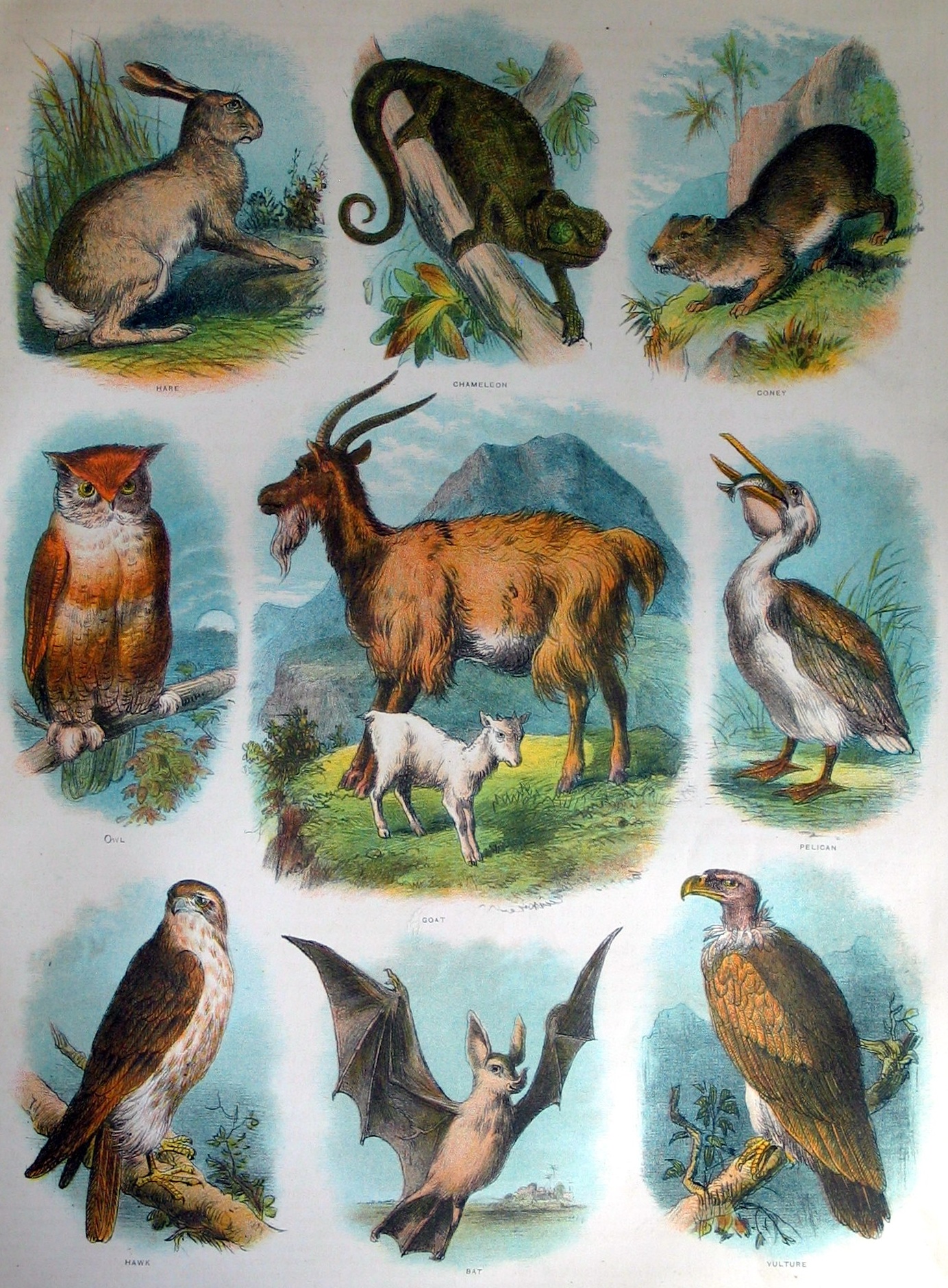
Leviticus 11:1-47, Clean and unclean animals. (5/12/2010)
Today's reading is a long one, but that's okay, because everybody enjoys a trip to the zoo now and then.
Clean and unclean are not the same as clean and dirty. Several years ago, I discovered a cockroach in the left basin of the kitchen sink. After the screeching and cockroach disposal were all over, my husband needed to put water into a pan. He was holding the pan over the left basin, and I threw a fit. He said, "What's the matter with that?" I said, "It's not clean!" He said, "It isn't even touching the sink!" I said, "It's not dirty, it's ritually unclean!" He said, "Oh," and filled the pan over the other basin. As a retired Baptist pastor, he perfectly understood the difference between clean and unclean, as opposed to clean and dirty.
Now, everybody knows that Jews (not to mention Muslims and Seventh Day Adventists) are forbidden to eat pork. There's a lot more to it than that. First, many other animals are unclean and therefore forbidden; it's just that we Christians, Jews, and Muslims typically think they're yucky and don't want to eat them anyway. Lots of other peoples do eat them, so probably the reason we think they're yucky is that Leviticus forbids them, and we've just forgotten that part.
Second, it's not just eating these animals that makes you unclean - touching their carcasses, or having one of their carcasses accidentally touch you or a garment or pan makes you, the garment, or the pan unclean. I was on solid ground about the cockroach, theologically speaking.
Third and most importantly, Leviticus is not about clean and dirty. It's about ritually suitable - i.e., clean - and ritually unsuitable - i.e., unclean. Only ritually clean animals may be eaten, because we have to be ritually clean in order to approach God, which is the point that God makes in vss. 43-45.
-
Reader Question: Did the Jews' use of animal skins make everyone "unclean"?
Leviticus 12:1-8, Purification after childbirth. (5/13/2010)
Yesterday we learned that lots of animals besides pigs are unclean, i.e., ritually unsuitable, and people or things that touch unclean people, or things, become unclean in turn. Unless there is some means of ritual purification, uncleanness is contagious; cleanness is not.
All this leads fellow-reader Nancy S. to ask whether there is any indication why some things were forbidden and some were not. The short answer to this question is "no." If you sort of fuzzy up your eyes, you can see that all land and air predators are unclean, and pigs are notorious for carrying trichinosis, which has led some folks to argue that the kosher dietary laws are about public health. Well, what about rabbits? They are vegetarians, and you can't eat them. Ah - can't eat anything that crawls on the ground, and rabbits are pretty close to the ground. Well, what about camels and horses? They are vegetarians and above the ground, and you can't eat them, either.
Another argument, probably with less foundation, is that a lot of the laws about what is forbidden arise from Canaanite religious practices: if the Canaanites did it, the Jews were forbidden to do it. Since we don't know a lot about their religious practices with regard to food - I personally have never seen anything on this topic - I don't think this argument holds much water.
So we get back to the answer, "no." A Jewish fellow-student when I was in grad school said that the reason is "because God said so." I think this is the correct answer. God probably has perfectly good reasons, and when we get to heaven, we can ask. Meantime, we don't know.
Another way of becoming temporarily unclean is to have a baby, as we see in today’s reading. We don't know why it's one week for a boy and two weeks for a girl. Ask when you get to heaven.
Leviticus 13:1-6, Leprosy. (5/14/2010)
Having more face to wash does not make you ritually unclean.
Priests were experts not only on sacrifices, but also on clean and unclean. Another way to be ritually unclean was to have a skin disease, and thus the priests had to be good diagnostic dermatologists. Yesterday we saw that unclean animals may or may not be a public-health issue, but skin diseases certainly are. Leprosy, or measles for that matter, is no joke in a pre-antibiotic, pre-hospital society. The only way they could stop the spread of disease was isolation.
Some of you may be interested that male pattern baldness is neither a skin disease nor unclean (Lev. 13:40-41). So losing your hair is not an excuse for missing church, guys.
Leviticus 17:10-14, The life is in the blood. (5/17/2010)
So why is there all this emphasis in Leviticus about animal sacrifices for sin? It's actually very simple. Sin is a matter of life and death. Once a sin has been committed, somebody will die for it. God has graciously granted that the sacrifice of a living animal can take the place of the sacrifice of the living person who committed the sin.
The life belongs to God, and the life is in the blood. Therefore, the blood belongs to God.
This is why the New Testament requires Gentile converts to refrain from eating blood and strangled animals (which retain the blood; Acts 15:13-21).
Leviticus 18:1-10, 21-30, Incest and abominations. (5/18/2010)
Years ago, we cut out a cartoon to put on the refrigerator; I have the idea that it might have been Frank and Ernest. One prophet was saying to another prophet, "Do you ever have days when everything seems like an abomination to the Lord?" Certainly the Canaanites had a lot of abominable practices - child sacrifice and assorted sexual perversions top the list - that God wanted the Israelites to have nothing to do with. We see a partial list in this reading.
Furthermore, God forbids a fair number of man/woman sexual and marriage relationships. Such forbidden relationships fall into the general category of "incest taboos." Some form of incest taboo is found in virtually every human society (and in many mammal and bird species, too, so don't go thinkin' that you are special). These taboos range from narrow proscriptions (e.g., father/daughter or brother/sister sexual relationships) to very broad and complicated proscriptions (e.g., marriage between any two persons between whom any sort of genetic or legal relationship can be traced), although the middle ground of "immediate family" (however defined) is probably the most common. Nobody really knows why incest taboos are so universal, although lots of theories have been proposed. Often, but not always, whatever incestuous relationships are defined are also the basis for proscribed marriages.
As a rule of thumb, the incest taboos of Western civilization are those of Leviticus.
Leviticus 19:1-4, 11-12, 20:7-10, 23:1-3, 26:1-2, Many commandments, including the Ten. (5/19/2010)
Leviticus has a lot of rules about the proper way and the appropriate occasions to sacrifice animals for the atonement of sin. It has rules for other kinds of sacrifices and offerings. It has a lot of rules about clean vs. unclean, how to tell the difference, and how to purify a person or thing that has become unclean. It has, as we see below, a lot of the commandments that are summarized in Deuteronomy, including most of the Ten Commandments. But all those rules are is not what Leviticus is really about. Rather, all those rules are a means to the end of becoming holy. Leviticus is about holiness.
Leviticus 25:1-22, Rest for the land. (5/20/2010)
You all know that one of the commandments is (roughly) "For six days you will labor and do all your work, and on the seventh day, you will rest." Sabbath is from a word that means cease or rest, and we all know that this commandment is about the "Sabbath day," on which we rest We saw similar commandments three times yesterday, however, and twice the word used was "Sabbaths." That's because there's actually more than one kind of Sabbath.
There's the Sabbath day that come at the end of every week. Surprise! Sunday is not the Sabbath day. Sunday is the Lord's day. Christians started worshipping (and resting) on the Lord's day instead of the Sabbath day in order to celebrate Easter every week. The Day of Atonement (Lev. 16) is a Sabbath that falls on the same calendar date every year, not on the same day of the week.
Then there is the Sabbath for the land, which comes in the seventh year. You may work your fields for six years, and then you must let them go fallow for one year. It has never been clear to me whether this is field by field, farmer by farmer, or the whole nation at the same time. (The concept itself is perfectly clear to me, though. Where I grew up, the wheat ranchers routinely let half of their fields go fallow every other year; there's not enough rain to produce a crop every year, so they have to let the fields save up water.)
The year of jubilee is a special year in which both you and the land rest, and there is a sort of general debt-amnesty. If you sold your hereditary property, you get it back. If you sold yourself as a slave, you go free.
Even though they are much more cheerful than the earlier chapters, the rules for Sabbaths and jubilee years are a lesser-read part of the lesser-read book of Leviticus. I suspect this is because they are near the end, and we all stop reading around the fifth chapter of instructions for sacrifices.
Leviticus 25:23-34, Redemption of property. (5/21/2010)
God's take on property rights is that He has them all. The rest of us are renters; however, the terms of our leases vary.
A person who sells hereditary property, which is mostly land, gets it back in the year of jubilee. Property inside a walled city can be bought back for a year after sale, but after that the seller loses all rights. (This must be the origin of title searches.) There are slightly different rules for the houses and fields of Levites, because the tribe of Levi did not get any tribal lands during Joshua's division of the promised land. Instead, they got specific cities scattered throughout the lands of the other tribes.
Copyright 2010, 2011 by Regina L. Hunter. All rights reserved.
The illustration is from the Binns family Bible, now in the private collection of Regina L. Hunter.
Opinions expressed on this page are solely those of the author, Regina Hunter, and may or may not be shared by the sponsors or the Bible-study participants. Thanks to the Holy Spirit for any useful ideas presented here, and thanks to all the readers for their support and enthusiasm. All errors are, of course, the sole responsibility of the author.
Our Sponsors:
St. John's United Methodist Church, "Transforming Lives Through Christ."
2626 Arizona NE, Albuquerque, New Mexico 87110
St. John's Music Ministries now has a YouTube channel, bringing you free concerts and choral music. Check it out!
Traditional worship services are held Sundays at 8:15 and 11:00 a.m. in the sanctuary. Casual worship services are held Sundays at 9:30 a.m. in the Family Life Center. Jazz Vespers are held monthly on the second Saturday at 5:00 p.m. in the sanctuary. St. John's feels especially called to the worship of God and to the service of our neighbors through our music program.
This website is supported in part by the generosity of Mrs. J. Jordan.