Chapters 8 - 17

The Gospel According to Luke

Luke 8:1-21, Crowds and the purpose of parables

Luke 8:22-39, In the Decapolis

Luke 8:40-56, Miraculous healings

Luke 9:1-17, Sending of the Twelve; loaves and fishes

Luke 9:18-36, Confessions and Transfiguration


Luke 9:37-56, A healing, and foolishness among the apostles

Luke 9:57-10:1-16, Sending of the Seventy-two

Luke 10:17-24, Return of the Seventy-two

Luke 10:25-37, The Good Samaritan

Luke 10:38-42, Teaching in private


Luke 11:1-13, Teaching in public

Luke 11:14-36, Criticism and debate

Luke 11:37-54, Lecturing the Pharisees and Lawyers

Luke 12:1-12, Warning against the Pharisees and against blasphemy

Luke 12:13-31, Warnings against covetousness


Luke 12:32-40, Money and service, Be ready!

Luke 12:41-59, Service and judgment

Luke 13:1-9, Suffering vs. judgment

Luke 13:10-21, Teaching and a Sabbath healing

Luke 13:22-35, Approach to Jerusalem


Luke 14:1-24, Another Sabbath healing and related parables

Luke 14:25-35, Parables about the cost of discipleship

Luke 15:1-10, Parables of the Lost Sheep and Lost Coin

Luke 15:11-32, A long and familiar parable

Luke 16:1-18, Parables about money, and comments on the Law

Luke 16:19-17:4, Parables and service

Luke 17:5-10, Grace and works

Luke 17:11-19, Healing ten lepers

Luke 17:20-37, Parables of the end times


More of the Gospel of Luke

Copyright information, disclaimers, and sponsors
Return to homepage
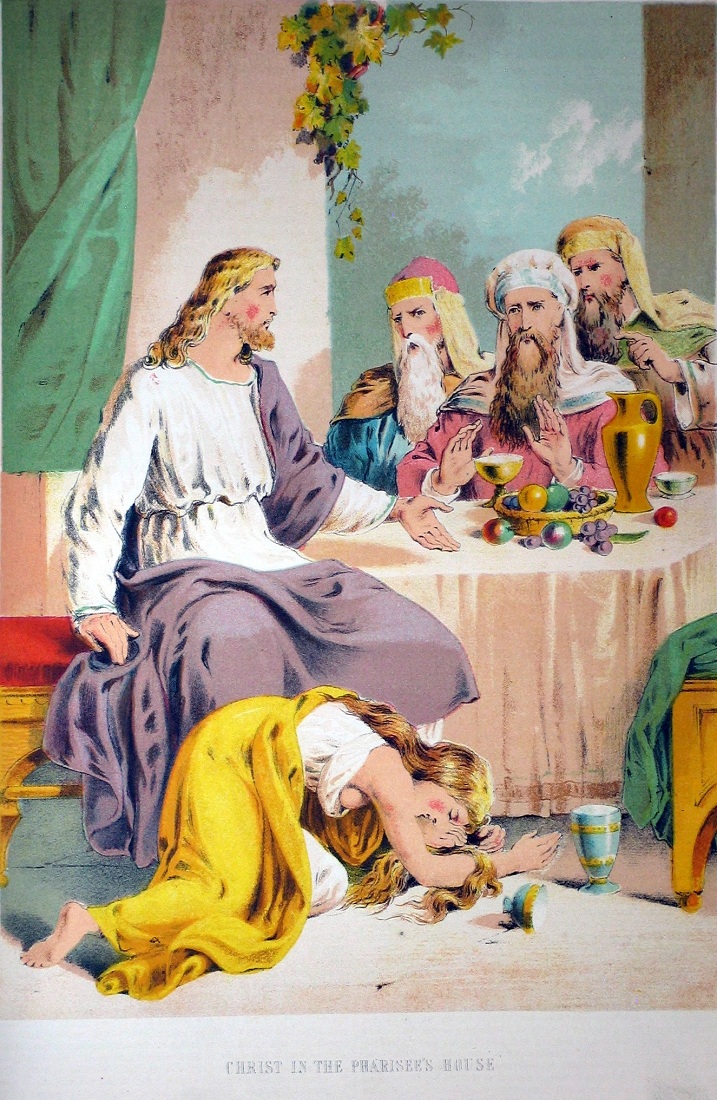

An unknown woman washed Jesus' feet with her tears. Click to enlarge.
This illustration showing the unknown woman washing Jesus' feet
is from the Binns family Bible, now in the private collection of Regina Hunter.
.

Luke 8:1-21, Crowds and the purpose of parables (5/26/22)

The only time I watch football on purpose is when the Oregon Ducks make it to a televised bowl game, and even then I usually read a book at the same time. Nevertheless, I know a lot about football because I've been married to a Denver Broncos fan for a long time. I understand the game because my husband talks about it. I see replays, hear commentaries, and learn the names of players, whether I'm interested or not. I'm like the great crowds of people who listened to the parables of Jesus: they heard the stories over and over from friends and relatives, and eventually they understood them, whether they were interested or not. In contrast, the disciples - who by the way included more than just the Twelve, see vs. 1-3 - listened carefully each time he told a parable, and they could recite it from memory. Whenever there was something they didn't understand, they asked for an explanation right away. They were true fans.

Only Luke mentions Joanna and Susanna by name, and while all four Gospels mention Mary Magdalene, only Luke says that she was present with Jesus before the crucifixion. Notice that several of these women had been cured of evil spirits and diseases. Evil spirits and demons cause disease, not sin. You will hear and read that Mary Magdalene, poor maligned woman, was a prostitute, but there is no scriptural basis whatsoever for that idea, so you can just put it right out of your head.

Luke 8:22-39, In the Decapolis (5/27/22)

There are so many superheroes running around the movie theaters and fantasy novels that the question, "What's your superpower?" has become a common catchphrase. But how would we feel if someone we knew turned out to have an actual superpower? Like maybe the power to calm storms or cast out demons from an untreatable ill man? We think we'd say, "Right on, Jesus!" Probably our true reaction would be the same as that of the disciples and the people of Gerasa: fear, astonishment, and the hope that he would go away without causing any trouble.

Mark, Matthew, and Luke all record the events we read about today. John doesn't; probably he thought they had been adequately covered by the earlier writers.

Luke 8:40-56, Miraculous healings (5/30/22)

I mentioned earlier that Matthew and Luke incorporate most of Mark, the earliest Gospel. Mark says the woman who touched Jesus' prayer shawl "had suffered much at the hands of many doctors, and had spent all she had, and yet was not a whit benefited but rather grew worse." Notice that Luke, who is a doctor, omits this detail, although to be fair, so does Matthew. Another thing to notice about this incident is that even though Jesus is being mobbed by people eager to see him or get something from him, he takes time to focus on individuals. We don't know how many other people benefited from his attention that day, but these two examples show that he is never too busy to pay particular attention to one person who needs him.

Luke 9:1-17, Sending of the Twelve; loaves and fishes (5/31/22)

Herod is puzzled, not to mentioned alarmed, about all that Jesus is reported to be doing, and he wants to see him. Only after Jesus is arrested and put on trial does he get his wish. Meantime, Jesus' mighty acts go on. Are you enjoying a Memorial Day picnic? Today we read about a picnic. The "feeding of the 5,000" is the only miracle reported in all four Gospels (I think; I'm sure someone will correct me if I'm wrong). Actually, there were probably considerably more than 5,000. Two words are routinely translated "man." One, anthropos, is common and really means "person." Women and babies are occasionally referred as anthropos. The other one, less common, is aner, and it means "adult male human," in contrast to "adult female human." All four Gospel writers say that the number of aner who ate was 5,000, and Matthew specifically says that there were also women and children. Another important point is that the crowd is reclining, as diners would, and Jesus and the disciples are preparing and handing around the food, as servants would.

Luke 9:18-36, Confessions and Transfiguration (6/01/22)

I just got back from a meeting, and among other things we talked about translations. I like reading a lot of different translations, because I get insights I never had before. For example, I really like the way Williams has "say 'No' to self" instead of the more usual "deny himself." What does it even mean to "deny myself"? But there are a lot of times I need to "say 'No' to self" just as I would say "no" to a little kid who was about to run into the street. Williams has given me a new insight here. On the other hand, I also get new insights from reading the same passage in the same translation for the umpteenth time; that works, too. The best translation is the one you will read.

Luke 9:37-56, A healing, and foolishness among the apostles (6/02/22)

The more times I read this passage, the more I became convinced that Jesus is speaking mainly to his disciples in vs. 41 when he says, "O faithless and twisted generation, how long am I to be with you?" After all, the man with the sick child seems confident that Jesus can cure him. So today I thought I might as well see if John Wesley has anything to say about this. He doesn't comment on Luke 9:41, but Matthew 17:17 is almost exactly the same, and there he says, "O unbelieving and perverse generation - Our Lord speaks principally this to his disciples. How long shall I be with you? - Before you steadfastly believe?" I should read Wesley more often and save myself some time and confusion.

Luke 9:57-10:1-16, Sending of the Seventy-two (6/03/22)

I just got an email from my grandson asking for advice about what to do at an upcoming job interview. The first sentence in my reply was, "Be really interested in the job." Then I read this scripture, and guess what? That's exactly what Jesus says to three people who apply for jobs as disciples. He tells the first one, "You'll be working for less than minimum wage." To the next one he says, "You won't have time for a second job." He tells the third one, "You have to start today." If you want to do the work of the kingdom of God, you have to make it a priority. You have to be really interested in the job.

Luke 10:17-24, Return of the Seventy-two (6/6/22)

A few years back, somebody asked whether Jesus literally saw Satan falling from heaven. I'm inclined to think that it's hyperbole, like when a friend calls to tell you how upset he was yesterday about the referee's call in the football game, and you say, "Yeah, I could hear you yelling all the way over here." But I could be wrong.

Luke 10:25-37, The Good Samaritan (5/12/09, 6/6/22

Pay attention to the debate between Jesus and the lawyer. This is what rabbis, scribes, and lawyers did. They studied the Law of Moses, they debated, they asked each other questions, they cited scripture and the discussions of other rabbis, scribes, and lawyers. Also pay attention to Jesus' answer: be kind to your neighbor, who is whoever you run into who needs your help. Only Luke reports the Parable of the Good Samaritan.

We saw before that when the foreigners to whom Peter was preaching heard the Gospel, the result was that they spoke in tongues, and it was by this result that the early Church knew that they had believed and had been accepted by God. Jesus was also interested in results as an indicator of belief. Jesus said that is not enough to know the Law: you must also practice the Law. The twist in the story of the good Samaritan is that the people who know the Law are the priest and the Levite. The person who practices the Law is the Samaritan. It's easy for us to feel superior to the priest and the Levite, because they lived a long time ago and most of us don't know what their jobs were. And we have all known since we learned to talk that a "good Samaritan" is a person who helps people in emergencies.

You will better understand the parable Jesus tells if you think of the first man, in vs. 31, as a Catholic priest. The man in vs. 32 is on the staff of a Methodist church. The man in vss. 33-34 is a terrorist. Jews and Samaritans hated each other at worst and had no use at all for each other at best. We've heard the phrase "Good Samaritan" so often that we forget that this was a complete contradiction in terms for Jesus' listeners. In their eyes, there was no such thing as a good Samaritan.

The Law says you must love God and love your neighbor. Probably all of us, if asked, would say that we do. The question is, if our lives were examined, would our practices say that we do?

Luke 10:38-42, Teaching in private (2007, 6/07/22)

Some years back we read a book in Sunday school about how Jesus spent his time. I noticed right away that something was missing, namely, teaching. Jesus taught practically all the time, to the point that many people who came to him addressed him as "Teacher," so I thought this was kind of a strange omission. We don't know the primary content of what Jesus was teaching at the home of Martha and Mary (a visit that only Luke records), but Luke does say that Jesus tells Martha about the relative importance of busy-ness and listening.

I want you to take a look at vss. 41-42. The verse numeration takes the last part of one sentence, "but one thing is needed," and sticks it into the next verse. Often the beginning or end of a paragraph is in the previous or subsequent chapter. Occasionally a single passage is spread out over two or three chapters. What difference does it make? By following the verse and chapter breaks only, you might take a piece of scripture out of its context and completely misunderstand it. It's like the old joke about the man who needed guidance. He closed his eyes and pointed at a verse: "Judas went out and hanged himself." Puzzled, he pointed again: "Go thou and do likewise." Annoyed, he pointed again: "What thou doest, do quickly." Always make sure that you understand the context of what you read!

Luke 11:1-13, Teaching in public (6/7/2022))

Notice that on this occasion Jesus teaches a slightly different version of the Lord's Prayer from that recorded by Matthew (Matt. 6:9-13). Jesus goes on to tell the Parable of the Friend at Midnight (a.k.a. the Importunate Friend) about the importance of not giving up in prayer. We also have this parable only from Luke. Finally, Jesus again compares God's way of giving to our way of giving, a topic he had discussed earlier in the Sermon on the Mount (Matthew 7:7-11). Jesus traveled and taught, and taught and traveled. It looks to me like he did what all teachers do: use exactly the same material, or slight variations of the same material, on different occasions in different places. Not everybody holds this position, so you can think what you like about it.

Luke 11:14-36, Criticism and debate (6/8/22)

So here's Jesus, casting out demons and making the mute speak, and some of the onlookers ask for a sign from heaven. The mind boggles.

The nature of the sign of Jonah is debated. It may be preaching and repentance, as in vs. 36, or it may be resurrection after three days in the tomb, or it may be something else altogether. No one knows for sure, so you are allowed to think whatever you want to think, and so are the people who disagree with you.

We often see Jesus talking to the crowds; notice in vss. 27-28 that he also talks with the crowds. Since we're reading Luke, we aren't surprised when he points out that Jesus is answering a woman in the crowd. We saw a similar example back in Luke 7:24-30, where Jesus is asking the crowd questions, but there Luke doesn't say how they answered.
Reader Question: In Luke 11:19, Jesus asks, "And if I cast out demons by Beelzebul, by whom do your sons cast them out?" Were others casting out demons at that time?

Answer: Well, apparently so, or at least they were trying to. Josephus, who was a first-century Jewish historian, reports (Antiquities VIII, II, 5) that Solomon developed skills and processes for expelling demons, and that he, Josephus, had actually seen this done, not only in his presence but in the presence of a number of Roman rulers and soldiers. It's especially interesting to me that the process used the name of Solomon several times. Acts 19:13-17 talks about some Jewish priests who were attempting to cast out demons in the name of Jesus; it didn't go well for them. Good question!

Luke 11:37-54, Lecturing the Pharisees and Lawyers (6/09/22)

Hahahaha! Jesus is criticizing Pharisees for their behavior, and a lawyer says, "Saying these things about them is also an insult to us," presumably because he recognized some of his own faults. Instead of saying, "Ooh, poor baby, I didn't mean to hurt your feelings," Jesus takes it as an opening to criticize the lawyers directly.

When you see "lawyers" in the New Testament, the law in question is the Law of Moses, that is, the first five books of the Bible. Lawyers were experts in the Law, but as far as I know they mostly studied and debated. Notice vs. 46. There was a tendency among the lawyers to make every commandment of the Law even more complicated by defining what it meant and then expanding the definition. For example, "Don't work on the Sabbath" might become "Don't even light a lamp on the Sabbath," so if your lamp went out, you had to sit around in the dark. If you notice it's about to go out, are you allowed to trim the wick? Can you use the last bit of flame to light a candle? Lawyers debated these questions all the time and imposed their answers on everybody else. We shouldn't be too critical though, because we are all lawyers at heart, as every parent knows.

By the way, I've read that the New Testament doesn't teaching tithing. On the contrary; see vs. 42.

Luke 12:1-12, Warning against the Pharisees and against blasphemy (6/10/22)

Today we have an excellent example of why I'm always telling you to read at least ten verses before and after the verse or passage you're interested in. Notice that we're in a new chapter, but we're still on the same topic. Jesus was talking directly to the Pharisees and lawyers about their hypocrisy, and now he's telling the crowds to be careful about the hypocrisy of the Pharisees. Verse and chapter numbers are the blessing and curse of Bible study. Without them, study - especially in groups - would be much more difficult. With them, we tend to be influenced by artificial divisions or connections.

Let's talk about blasphemy against the Holy Spirit (vs. 10). Everything from Luke 10:1 to 18:14 appears to be unique to Luke. Since he says right at the get-go (vs. 1:3) that he intends to set forth "an orderly account," let's presume that he talks about things in the order they happened, as best he can. In 11:14-15, Jesus casts out a demon, and some of the onlookers in the crowd accuse him of being in cahoots with Beelzebub. The crowd grows (11:29), and "when he had finished speaking," a Pharisee asks him over for a meal (11:37). While he is eating, the crowd grows to "many thousands" (11:53-12:1). He tells this huge crowd that "the one who blasphemes against the Holy Spirit will not be forgiven" (12:10). It looks to me as if this is all part of essentially the same conversation on the same day. Probably this is what has led many people to conclude that blasphemy against the Holy Spirit is attributing the works of the Holy Spirit to Beelzebub (or the Devil), as in 11:14-15, and that seems reasonable to me. Other people have concluded that we have no clue, and presumably others have some other idea. You have to read for yourself and read the whole context. My advice: don't blaspheme on purpose, and you'll be okay, since I'm pretty sure you can't do it by accident. (Not everybody agrees with that either, by the way.)

As an aside, people who send emails, or post things on social media, or use cell phones, or write letters, or tell secrets, or engage in any form of communication whatsoever, should pay close attention to vss. 2-3.

Luke 12:13-21, Warnings against covetousness (2007)

Back in the old days, when the Spirit of God rested upon a person, that person was called a judge (as in, the book of Judges). Typically the judge began as a military leader, but once that was over, the judge continued to judge the people until his or her death. In today's reading, a man comes to Jesus and asks for a judgment. The CEV says, "Who gave me the right...?" In other, more literal translations, Jesus asks, "Who made me a judge or a divider over you?" Notice that Jesus does not say, "I don't have the right" - in fact, in the book of John, Jesus several times refers to himself as a just and righteous judge. Rather he asks the man, and the crowd, to think about who gave him the right, already acknowledged, to give judgments.

Luke 12:32-40, Money and service, Be ready! (2007, 6/13/22)

Bob Dylan wrote a song about the second coming called "Are you ready?" The verses talk about the state of our souls and the events of Jesus' coming, and the refrain is "Are you ready? I hope you're ready." Dylan's song could be based on today's reading from Luke.

Jesus told a lot of parables about the importance of readiness, and in fact we read one earlier in Chapter 12 that made fun of the fellow who wanted to build bigger barns, only to learn that his time was up. Today's parables are for those who missed the point the first time; they refer more explicitly to the return of the master. Are you ready? Be ready!

Luke 12:41-59, Service and judgment (6/14/22)

Jesus has just told some parables about servants who are rewarded because they were ready when their master comes home, and Peter wants to know if the parable is about him and the other disciples. Jesus repeats that parable in different words, but then he tells a parable about servants who aren't ready! Be ready.

Then in vs. 48, Jesus quotes Peter Parker's Uncle Ben, saying, "With great power comes great responsibility." (Or maybe Uncle Ben was quoting Jesus.) So this is a perfect opportunity for me to remind you that you have to read your Bible for yourself. Don't take my word, your Sunday school teacher's word, or your pastor or rabbi's word for what's in it. The more responsible you make us, the more trouble we will be in if you don't understand it.

Luke 13:1-9, Suffering vs. judgment (2007, 6/15/22)

The passage from Luke is a bit puzzling, even to scholars. The incident Jesus refers to in vss. 1-2 is not certain, and the incident in vs. 4 is unknown outside this passage. The question of why terrible things happen to people is an ancient one, and normally we want to find somebody to blame. If necessary, we will blame ourselves, even if we had nothing to do with it, because the idea that somebody must be to blame is deeply ingrained in the human psyche.

One day some folks come to Jesus and tell him about a massacre of Jews. Now in this case, Pilate is clearly to blame, but Jesus doesn't focus on that. His focus is one nobody wants to hear: terrible things happen indiscriminately to good people and bad people. He even goes further: maybe nobody is to blame. Sometimes towers fall and people die. Then he follows up with a story about God's long-suffering forbearance. The next time you are suffering (and, sorry, there will be a next time), ask yourself, "Was I just in the wrong place at the wrong time?" If you can rule that out, then you can ask, "Is this suffering the obvious, clearly connected, result of my own sinful decisions? Did somebody do this to me out of ignorance or malice?" Don't assume that God is dishing out suffering as a punishment for some obscure sin that you can't even remember.

Nevertheless, two things are clear:

Luke 13:10-21, A Sabbath healing and teachings on the kingdom of God(2007)

Various commentaries interpret the parable in vss. 6-9 in various ways, so I'll tell you how I see it. God owns the vineyard, and Jesus is the gardener. We are (or I am) the unfruitful tree. We (or I) deserve to be cut down. Jesus intercedes for us and gains us some time for repentance, but if we don't become fruitful by responding in faith, even he can't save us.

Luke 13:22-35, Approach to Jerusalem (06/16/22)

People were always asking Jesus hard questions, and today's question continues to be asked up to the present time. "Lord, are only a few to be saved?" Jesus seems to answer, here at least, only the negative of the question: "Will everyone be saved?" His answer to that seems to be "No." There's a lot of room, however, between "no comment" to the positive and "no" to the negative, and Christian denominations pretty well cover the map in between. For example, Jehovah's Witnesses say that 144,000 persons will go to heaven, although a bunch of others will get everlasting life on earth. United Methodists say that salvation is universally available but (sadly) not universally accepted. Universalists say that no one will be condemned forever. A few denominations (not most, in spite of what you might see on the Internet) seem to think that only they will be saved.

If you remember our long study on salvation, or maybe even my long comment on "once saved, always saved," you know that I stand four-square with the UMC, because I know God loves you and is trying hard to save you. The only person who can get in the way of that plan is you. Please don't.

Luke 14:1-24, Another Sabbath healing and related parables (06/17/22)

Apparently, Jesus was invited to a lot of dinners, and this makes sense, because if somebody famous came to town, you might invite them to your house. You might want to find out something you can post on social media (vss. 1-6). You might want it known that you are worthy of the attention of somebody famous (vss. 7-11). You might want to show the famous person that you know a thing or two yourself (vs. 15). You might want to be careful, because Jesus had something to say about all these motives.

Let's think more about vs. 15, "Happy will be the man who is fortunate enough to be at the feast in the kingdom of God." The man who said that is at a feast in the presence of Jesus! I get what he's saying, because I want to go to heaven, but not, you know, today. Jesus tells a parable about people with this attitude. They are invited to a great dinner, but they don't want to come, you know, today. Oops. The fellow giving the dinner isn't willing to delay the feast, but he is willing to fill his hall with people who weren't invited in the first place but are ready to come.

Luke 14:25-35, Parables about the cost of discipleship (06/20/22)

Verse 26 can be bothersome. Who among us thinks we should hate our family members, let alone our own lives? Aren't we told to love one another?? Well, this is an idiom. Love/hate is a Hebrew idiom that means love more/love less, and it has come over into the Greek of the New Testament. This particular saying is made clear in Matthew 10:37, "Anybody who loves father or mother more than he loves me is not worthy of me." We are supposed to love God first and foremost, and to love our neighbors, which includes our family members, as ourselves. This is a more accurate, as well as more palatable, interpretation of what Jesus was saying.

Luke 15:1-10, Parables of the Lost Sheep and Lost Coin (2007, 4/24/2009

In addition to the charge of Sabbath-breaking, the Pharisees and scribes tried to stir people up because Jesus supposedly defiled himself by associating with tax collectors and sinners. Now, most of us would probably be happy not to pay taxes, but we don't normally lump tax collectors with sinners. Tax collectors were Roman collaborators - they didn't just collect taxes, they were contractors who extorted as much as they could, paid what was due to the hated Roman occupiers, and then kept the rest. So most of them probably were sinners in the ordinary sense of the word "thieves." Nevertheless, Jesus wants to point out to the Pharisees and scribes that sinners are exactly the people he has come to gather back to God. He tells them three parables about the joy of finding lost things: a lost sheep, a lost coin, and a lost son.

The best news about sinners is that Jesus is friendly with them. If you know someone who is worried that he or she must be a good person before coming to church, tell them the stories we're reading today. God and all his angels are happy when a sinner turns around and comes back home! So our goal, through the grace and with the help of the Holy Spirit, is not to commit sins; however, no matter how many times we turn away, God is always excited when we turn back.

Luke 15:11-32, A long and familiar parable (2007, 6/21/22)

The Williams New Testament uses the word "story" instead of "parable." I like that for a couple of reasons. Second, it's a more accessible word for readers who didn't grow up in the church. But first, a parable is a story! Biblical scholars tend to define a parable as "a short story with a single theological point," which is pretty good, except that some of the "parables" are really allegories (everything stands for something), and some are just metaphors or similes (something is or is like something else) and not really stories at all.

Today's famous parable is an allegory. The Father stands for God. The younger son stands for the person who rebels against God and later comes back. The property is probably a place in the kingdom of heaven. The older son stands for the person who doesn't rebel and can be pretty grumpy about the welcome given to the rebel who returns. Just as in the two stories we read yesterday, the party stands for the joy in heaven when a sinner repents and returns to God.

Sometimes I feel like the older son - continuing to do my job for the Church but having to watch while some egregious sinner gets a lot of good press for repentance (vss. 29-30). Wesley points out that the elder son still has the complete inheritance: "God's receiving notorious sinners will be no loss to those who have always served him; neither will he raise these to a state of glory equal to that of those who have always served him, if they have, upon the whole, made a greater progress in inward as well as outward holiness." So we win either way. If we are egregious sinners, we can repent. If not, we have more time to go on toward perfection. Either way, God wants us to accept the salvation he offers in Jesus Christ.

Luke 16:1-18, Parables about money, and comments on the Law (2007, 6/22/22)

Hahaha! The manager (often called a steward) in Luke 16:1-8 is ashamed to beg, even though he's not ashamed to steal! Wait... how many of us are more ashamed of the little things like not tithing our mint and dill and cumin than of the big things like neglecting justice and mercy? Maybe this parable isn't as funny as I thought it was. Jesus tells us the point of the story in vss. 10-12.

Today's passage is about wealth - spiritual wealth and worldly wealth, which are intimately related to each other. Some denominations preach that worldly wealth is necessarily bad, and that it will impair your spiritual well-being. Others preach that spiritual wealth will necessarily lead to worldly wealth; therefore worldly wealth is good. The United Methodist Church teaches that spiritual wealth will make us wise stewards of our worldly wealth, and wise use of our worldly wealth will increase our spiritual wealth. Just the other day, Pastor David commented about the questions people ask at the pie cafe. He asked, "What if we were as cautious about the ingredients in our own lives? What if we were as concerned about the things that take up space, demand our time, mortgage our pocket books, and consume our lives?" We need to be concerned about using our worldly wealth to promote our spiritual wealth, and not the other way around.

Almost all of Luke 14-16 is unique to Luke's reporting. We don't have any evidence that he ever saw Jesus (or that he didn't), but he does seem to have done quite a bit of work to track down stories of Jesus that are otherwise unrecorded. Think about it. Without Luke, we wouldn't have the parables of the delinquent banquet guests, the lost coin, the prodigal son, or the crafty steward, and how much poorer we would be!

Luke 16:19-17:4, Parables and service (06/23/22)

Does your family break out the reference books on Christmas morning? Ours does. A few years ago one of my sons received a tee shirt with two large, evil eyes and the message, "FEAR THIS. 'And he lifted up his eyes, being in torment.' (Luke 18:23) Don't let it be you!" Like Mary, we pondered what kind of greeting this might be - that is, we discussed what passage it might be from. So we looked up Luke 18:23, and that reference wasn't correct. We got out various concordances and quickly located the correct story, which is today's reading. We reexamined the tee shirt, and it did have the correct reference, but there was an extra dot of ink on the 6. Note that the rich man is not being punished for having money. He is being punished for loving his money - that is, for not using some of it to take care of the sick beggar at his gate. As you read the parable from Jesus, fear this! Don't let it be you!

This is another parable that we have only from Luke. It's an excellent example of the "single theological point," which Jesus gives in vs. 31, namely, some people already have their minds made up, and they can't be confused by the facts. It's important not to get more out of a parable than Jesus put into it. For example, if we were to read vss. 25-26 literally, all by themselves, we could conclude that the blessings of God are a zero-sum game. That would mean that the more blessings you get, the less I get, but in fact, we know that the blessings of God are boundless.

Also remember that the chapter and verse divisions are artificial. If you take 17:1-4 as a further explanation of the parable, then the rich man is now in torment because he didn't take pity on Lazarus. It's our responsibility to watch out for both of these folks - both to do something about Lazarus ourselves, and to warn the rich man that he's headed for trouble, but he can repent and be forgiven. On the other hand, these four verses could be an independent comment. Either way, they don't seem to me to be all that closely related to what follows in Ch. 17.

Luke 17:5-10, Grace and works (2007)

The problem of works vs. grace is a thorny one, and Jesus has a few words to say on that issue today. Here are the main points you need to remember:
We should never fool ourselves into thinking that good works are optional.

Now, it just so happens that our gracious God attaches value to our good works, in the same way that a grandparent attaches value to the artwork of a little child; nevertheless, we should also never fool ourselves into thinking that our good works would have any value at an auction.

Luke 17:11-19, Healing ten lepers (2007, 6/24/22)

Notice that Jesus had to go through Samaria and Galilee to get to Jerusalem, which is in Judea. See the map. If he went "through" both Galilee and Samaria, he started this journey somewhere in the north, maybe around Caesarea Philippi, near the center of B4, but he may have already been in Galilee somewhere.

It was against the Law for lepers to approach healthy people. This is why they stood off at a distance and raised their voices. Jesus sends them to the priests because only a priest could determine that a leper had been healed and made ritually clean. Even when Jesus healed them, they couldn't legally be readmitted to society without the priests' say-so. The rules are complicated. You will find them in Leviticus 13 and 14. The Jews had to visit the priests to be declared clean now that they were cured, but the rules did not apply to foreigners. The Samaritan doesn't need the priests' approval, so Jesus sends him on his way.

Samaritans and Jews despised each other, so Jesus and Luke call attention to the fact that the despised foreigner thanks him and praises God, and the Jews who were cured do not. Jesus always expressed amazement when he saw outstanding faith on the part of foreigners. I wonder whether he was actually amazed. Possibly he was feigning amazement in order to hold them up as an example to the Jews, who had less faith than they should have had, given what they had seen, not to mention a low opinion of foreigners.

Luke 17:20-37, Parables of the end times (06/24/22)

Notice the contrast between the kingdom of God, which is within us but may go unnoticed, and the coming of the Son of Man, which will be unmistakable.

Also notice that vs. 36 is omitted. Older Protestant translations usually have this verse, "Two will be in the field; the one will be taken, and the other left." The Vulgate and older Catholic translations have, "They answering, say to him: Where, Lord?" Newer translations, based on better Greek manuscripts than were previously available, tend to omit it entirely. If you don't have a modern translation, you should. With footnotes. And cross-references. Have I said that before?

More of the Gospel of Luke
The Gospel According to Luke - Chs. 1 - 7
The Gospel According to Luke - Chs. 18 - 24